Showing posts with label House Rules. Show all posts

Tuesday, May 28, 2013

Weighing Wealth, Weighing Words

At my table, I have preferred a simple encumbrance system based on the ancient stone weight measurement, where one stone is equivalent to 14lbs. Recently I noticed that the Adventurer Conqueror King System also prefers measuring by stone (albeit at a slightly different conversion—the historical stone changed in value over time), which inspired me to flesh out my encumbrance system in more detail.

Like others before me, I prefer to keep a ratio of 1,000 coins to one stone, so that there are 72 coins per pound (incidentally, I do not use pounds for any measurements in the game). This is closer to ancient treasure caches like the Frome Hoard and steers clear of the implied chunky coins of Dungeons & Dragons. From this basis, I permit each character to lift up to their Strength characteristic in stones, which comports closely in effect to later editions of the game (so that an average Strength 11 allows one to carry 154 lbs). However, moving at any more than a shuffle requires that the carried weight also not exceed the character's Constitution (representing their stamina). Furthermore, acting carefully (such as climbing, walking along an edge or fighting) requires that the load also does not exceed the character's Dexterity. To maintain balance, the hero has the option to drop everything in hand or risk falling otherwise. Thus, a character with Strength 12, Constitution 9 and Dexterity 14 could carry 12 stones, but could only move normally if this burden was reduced to 9 stones (the lowest of Strength and Constitution). Likewise, the hero could only fight if the burden was 9 stones (as acting carefully takes the lowest of all three scores).

Within this system, I tend to handwave equipment weights. I generally rule that light adventuring gear (clothes, a bedroll, backpack, candle and so on) only weighs two stones, while more extensive gear (torches, iron spikes, rope and so on) would increase this to three stones. Each weapon and all of its ammunition (beyond a dagger) is one stone each, as is a shield. Armour is typically one (AC 8 to 7), two (AC 6 to 5) or three stones in weight (AC 4 to 3). As mentioned earlier, each bag of 1,000 coins is another stone of weight. Everything else is made up on the spot, perhaps using Vornheim's syllable-counting system for heavy items (i.e., a "chest of trea-sure" could be four stones).

Addendum: While developing the system I had informally used at my table, I noticed that these same rules might be used to cover something entirely different as well: the tense diplomacy and maneuvering of social interactions. Here, a player will make a reaction roll of 2d6, modified by any Charisma adjustment. The referee then listens to the player's attempt to roleplay the encounter and secretly rolls a polyhedral die based on the roleplaying and the hidden disposition of the other party (normally a d6, but this could be a d4 for an accommodating stranger or a d8 or worse for a hostile group). Adding this disposition die to the adjusted reaction roll, the referee compares the sum to the speaker's Charisma score: if the result does not exceed the score, the party is not immediately hostile. Then, if the player attempts to maneuver or trick the non-player characters, this same value is similarly compared to the Intelligence of the spokesperson to see if he or she gives away the ruse. Finally, if this sum also does not exceed the Wisdom of the speaker, the player can pick up some subtle hint in the opponent's speech that gives clues to something they did not intend to reveal (but only if the Charisma eased the first contact and the player did not fail an attempt to trick or deceive the opponents). In this way, such a tense encounter would be based on both the roleplaying attempt and the scores of the character, so that each party would have a spokesperson. At the same time, such encounters would always be a gamble because the players only had half of the information and the disposition die result that completed the negotiation score would be hidden.

Tuesday, May 21, 2013

The Thieves' Guilds of Minaria

The poor thief has been the subject of many debates and contentions since his incipient introduction in Supplement I: Greyhawk. The most common complaint falls upon the low starting ability of the thief class. It is true, with most special abilities starting at 10% to 15% chance of success, the thief can hardly feel "special," but is instead discouraged from risking his neck on his dubious skill set. In fact, these scores only improve to an even 50% somewhere around 7th level in most editions of Dungeons & Dragons, when the thief's fighter and magic-user compatriots are well on their way to obtaining the defining features of those classes. The other common grievance is that the thief class is either unnecessary or even inimical to a proper Dungeons & Dragons play experience. When the thief was introduced to Original Dungeons & Dragons, he largely co-opted and made exclusive certain adventuring abilities that all dungeon-delvers had previously shared. Common skills such as climbing, trap-finding and lock-picking were suddenly the sole prerogative of the doughty thief, who seemingly had no other function in the game than to encompass all of the competencies once enjoyed by the original adventurers. Instead of stealing treasure, thieves had stolen adventuring proficiency from the other characters.

Feeling the acute loss of fundamental dungeoneering capabilities, some referees qualified these "new" thief skills with the superlative: as Robert Fisher suggests, perhaps all classes can move quietly, but only thieves can move utterly silently. Yet, this approach does not address basic skills like lock-picking or trap-finding—talents that adventurers previously benefited from but were now bereft of. It also did not confront the relatively low chances of success of novice thieves, which rendered their skills prohibitively futile. Other house rules diminished the great difficulty of these dice rolls by granting significant bonuses for easier challenges—a rusted lock or a crude trap door, perhaps. This latter method only solved the clumsy low-level thief by effectively ignoring the rulebook, creating a balanced skill progression where a thief always faced challenges relative to his skill and therefore had comparable chances of success regardless of level (perhaps the very antithesis of early Dungeons & Dragons).

So what is to be done about these dual problems—the loss of common adventuring abilities from other characters and the relatively ineffective ability of the low-level thief? In Minaria, thieves are a vital part of the party, and any party that enters the dungeon without at least one or two in tow is in severe danger. Of course, any character has the same ability to explore the tricks and traps of the mythic underworld—I listen to their descriptions, look at their character sheet and then let them try their luck on a single polyhedral die (perhaps 3 in 8, or 5 in 12, or 2 in 6 and so on). I will even let the player pick her favorite lucky die and then adjudicate the odds for that die type. This approach demands that the referee give a clear description of the terrain and the player gives a clear description of her action, but this action is open to any and all characters (thieves included). However, if the players cannot figure out the trap by asking questions, or if they get a close guess but botch the roll, only the thief has a second layer of defense. Here, the thief's training and skill competency kicks in, and after failing the earlier attempt the thief can make a free, back-up saving roll on the Thieves' Abilities table. These bonus odds are on top of the regular effort, and are a second chance that can rescue the party regardless of whether they have figured out the trap. Played a different way, the party can skip the initial roleplaying and just have the thief roll the ability check. If this is successful, the trap is automatically described and bypassed and the adventure continues without pause. If this fails, the party must take a closer look at the trap and roleplay their attempt to manually disarm it.

At later levels, when thief skills become very high, it is likely the party will increasingly rely on the latter method—making initial recourse to the thief skill to see if the roleplay element can be dispensed with and more exciting parts of the dungeon can be accessed more quickly. At earlier levels, however, the party will enjoy the grittiness of dealing with traps and tricks more directly. Still, all characters should have a chance to open locks, remove traps, pick pockets, move silently, climb sheer surfaces and hide in shadows, at least when they describe a reasonable strategy and have character scores to support it. When the dice turn against such dungeon-delvers, however, thieves have a second chance to catch their fall. Sometimes, the narrated attempt will be unreasonable, and the referee will simply have to say No. Even when such practical constraints limit normal classes, though, thieves should still get their chance to snatch victory from defeat. By allowing thief skills to operate like an extra safety net for dashing heroics, thief characters are encouraged, not discouraged, from using their abilities.

Thursday, May 16, 2013

The Money-Changers of Minaria

Dealing with coin has always been one of the most utilitarian exercises in any Dungeons & Dragons campaign. It is a necessary evil that all referees and players engage in to translate conquest into capital. It is also one of the facets of the game that most stretches the imagination and suspension of disbelief, raising thorny questions like "why should all coins have a constant universal value across the entire expanse of the Known World?", "why are coins always evenly divisible into lesser or greater coinages?" or "why should these ancient coins from the dungeon still have currency back in the town?" The implication is that the fantasy setting has achieved what took Europe to the last years of the 20th century to figure out—a stable, universal currency system.

Of course, there are many different ways that game designers have tried to complicate the picture. Medieval fantasy markets might be tempered by inflation tables, availability charts or conversion rates. A referee might declare that each kingdom has its own coin mint and may not accept coinage from opposing lands. Applying any of these methods in an actual campaign quickly proves both highly complex and ultimately ineffective. It misses the point, after all. We are still dealing with the unholy triumvirate: Copper, Silver and Gold pieces. (Or is it the gruesome five: Copper, Silver, Electrum, Gold and Platinum?) No matter what additional layer of complexity you add to your campaign economy, you are still dealing with the universal basic building blocks of wealth, which convert dungeon triumphs to points of abstracted "cash" or "wealth."

In Minaria, everything works a little differently. You don't delve into the earth to plumb it for copper pieces and gold coins. Instead, you emerge (battered and shaken) with 1,350 coins from the lost Cisterian empire. Or perhaps you return from the Bugbear lair with the Duke's own personal treasure—some 560 shiny pieces of lucre. Here we find no generic points of wealth, but coinage with a story attached to it. As the greater part of Minarian society operates on barter, the heroes will need to find a buyer for their precious take, which is to say that the coins themselves do not necessarily hold inherent value as currency. Inn-keepers and armourers can do little with such moneys as they rarely take payments in specie, and flashing strange coinage around would likely raise the immediate and unwanted attention of the local Duke or Baron. Rather, the protagonists are well-advised to seek a local money-changer; someone who will buy the storied cache in exchange for credit in the local town, city or region. Once the heroes have successfully laundered their fortune, they will have full financing for their extravagant lifestyle and material acquisitions. For example, the players return with 800 tarnished silver coins of southern Kushite origin. After some negotiating, the major money-lender in the city agrees to purchase half of them for 220gp in credit, good throughout the province. This credit advance is probably in the form of some local currency (or perhaps a standing tab, or even an endorsed cheque)—a detail that is given a considerable amount of handwavium to gloss over the trivialities. Importantly, however, this credit does not carry over into different regions, meaning the protagonists would be wise to only sell what they need to of their hard-won treasure.

What does this actually do differently than the traditional copper piece, silver piece and gold piece system? Firstly, it introduces a level of mystery when the treasure chest is opened and the gleaming treasure trove is seen for the first time. Secondly, it further requires a little haggling when it comes time to pawn the riches off (which allows more referee control and even future adventures, if the party decides to sell the coins at a neighboring kingdom instead of locally). Thirdly, it gives each treasure a story of how it got there (and certainly the Baron will demand his coins back after the party recovers them from the sunken wreck). Finally, it ties wealth to the locale, without requiring the referee to adumbrate an entire global economy to explain why.

Sunday, March 3, 2013

Alcoholism in Warhammer Fantasy Battle

First introduced in Warhammer Fantasy Battle 2nd Edition, the special rules for alcoholism only managed to sneak into one campaign module (Tragedy of McDeath, 1986) before disappearing from the game thereafter. Admittedly, the rules were someone clumsy—they simply punished the player by penalizing the drunken unit with lower characteristics. Nevertheless, in the spirit of Oldhammer, I've drawn up a quick treatment of these forgotten special rules for use with the 3rd Edition that is a little more random and fun. Enjoy!

Alcoholism: If the scenario calls for it, one or more units in your army has been 'at the bottle' and is well and truly drunk. Throughout the fight, they will continue to drink from whatever alcohol they carry with them. At the beginning of each turn, take a Will Power test. If the unit fails, they have become well and truly drunk and will react randomly according to the table below. If the Will Power test is passed, then they have managed to hold their liquor for now, and there is no effect for the turn.

Roll 1d6 each time the Will Power test is failed:
1-2 Until the beginning of the next turn, unit is subject to a failed Stupidity test.
3-4 Until the beginning of the next turn, unit is subject to a failed Saga Animosity test against the nearest visible unit (friend or foe) to its front.
5-6 Unit will spend the turn moving towards the closest known building in search of more alcohol (or otherwise, the table edge). If they reach the building, they will spend the entire next turn trashing the place and turning it upside down to find any hidden stores.

Thursday, August 9, 2012

Questers into the Unknown

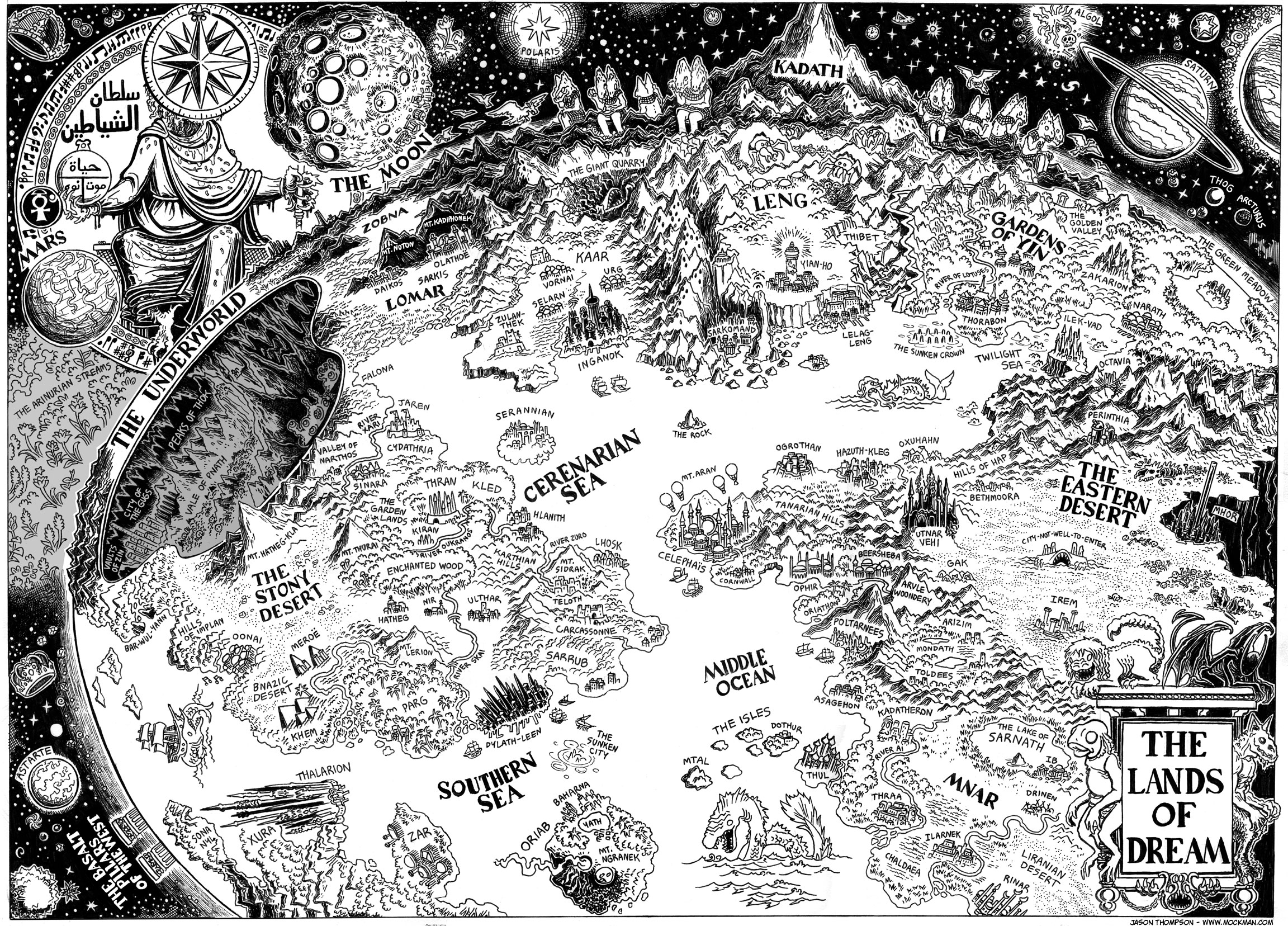
I have been working again on Questers, this time translating it to Dungeon World. So far, this is my progress. Let me know what you think, and I will add it to the blog Treasury for future access. Credit where credit is due, it owes a lot to Vincent Baker (Apocalypse World), Sage LaTorra and Adam Koebel (Dungeon World) and Ryan Stoughton (E6 D&D). And while we are at it, here is an excellent map of Unknown Kadath.

Wednesday, August 1, 2012

Bonded to the World

In many ways, how players are rewarded at the table will define your game, and thus your game world. After all, the world only comes to life in response to the players' action (or inaction), which is then driven by their goals. Rewards give the players an indication of what they should be doing, generally speaking. At the same time, rewards are much more than mere incentives, which would lead players along a predesigned course. Rather, how the players go about achieving these rewards is unique to each group and to each story, and thus rewards must be open-ended. As mentioned in the previous article, players should always be given problems, not answers. How they answer problems is an expression of their freedom within the game world, and is the very narrative of the story itself.

Perhaps a good example of this can be seen in "Old Geezer" Mike Monard's fascinating on-going "tell-all" about the early days of Dungeons & Dragons. As he describes, experience awarded for defeating monsters in the Greyhawk dungeon was almost nothing, perhaps only enough to round off the experience gained from treasure, and that in his own games he does not reward any experience for monsters. The picture that immediately forms is one in stark contrast to modern "dungeon delving" games, with the players cast as "amoral mercenaries out to loot the dungeon," as one commenter put it. Where there is no reward, there is no risk-reward structure, and thus monsters are carefully avoided, like elite soldiers sneaking deep behind enemy lines in some subterranean fantasy Vietnam.

In the same way, a game that does not have a clearly identified reward structure is a game (and a game world) with an identity crisis. Without a framework of rewards (whether fame and fortune, or something else entirely), the players will not have a clear idea of what they should be doing. Without player action to fuel it, the world cannot come to life. This is probably one of the most discussed aspects of Dungeon World, still a work-in-progress, and several iterations of an "experience" system have been proposed (experience being one way to quantify reward).

One of the options that has gained the most traction, although not the current "official" solution, is Ryan Macklin's experiment. A hold-over from the primogenitor game Apocalypse World, this system has each player pick a basic strategy for another player to pursue that session (such as pulling stunts, defending others, acting diplomatically, solving possibles and so on). Each time the player acts accordingly, they earn experience, rewarding immediate and short term narrative styling. Thus, a Cleric (bidden to be more aggressive that session) will show a new angle to his character, as he beats the goblin he interrogates, or lashes out at his superiors in the monastery.

This is a fine system in itself, but perhaps more suited to the game it originated from (Apocalypse World is all about psychologically breaking characters down in a ruined world where no one is granted tomorrow). As forum-goer nemomeme points out, the reward structure determines what the very game is about. We must be careful to think about the essential design goals behind the game before tackling rewards.

So what is adventuring about? The very principles of Dungeon World (which make it so interesting and unique) demand that the fiction comes first. Like microgame adventures, the rules are discrete components that have specific triggers from the fiction, and are otherwise out of sight. The principles also state that the game is a conversation, so thus the rewards should also be in conversation. Perhaps a good model for reward, which is based on the fiction and also in constant conversation, would be Jeff Rient's article on "eXPloration".

Here, I can imagine players and referee discussing, as a group, what they want to do, as it comes up in the fiction. They could even create "experience ladders," listing some goals and objectives. Once players have achieved (or failed) all of their plans for a front (a living, breathing local situation), and the game master has no more moves to make, this should indicate that the front has been fully explored and the next expedition should be chartered. Each player might have a different list, but commonalities and overlaps are expected, as the party is acting within the same local area. An example might be:

• Find the slave camp deep in the jungle (+1 Exp)
• Defeat the Guaraxx lurking in the delta (+2 Exp)
• Get revenge on those pirates (+1 Exp)
• Discover what has made the villagers so frightened, and make it safe again (+2 Exp)
• Climb to the top of White Doom Mountain (+3 Exp)
• Spend a night in the Lost City (+1 Exp)


These goals are constantly being discussed, revised and traded as the fiction dictates, and represent paths of action parallel or tangential to the plot of the front. They give the players a clear idea of what this world is about (that is, the cool and amazing things to do and see, the supernatural adversity to overcome and the bonds to play off between players in the process). In fact, in many ways, this is merely an extension of the bonds rule from Dungeon World, which gives players an initial motivation before the first front is even encountered. Here, in addition to being bonded to each other, the players are bonded to the world. Most importantly, this method lets the fiction come first, which is an essential quality of Dungeon World, and a great deal of what makes it so unique.

Monday, April 16, 2012

Player-Facing Initiative

There is a nice effect that goes along with keeping monsters mechanically freeform. From planning to implementation in the campaign, such enemies remain open-ended in the minds of both the judge and the players. The unknown shifts from simply "what the players cannot see behind the judge's screen" to the unknowable, as it draws from the vague and unthought potential of the judge's ongoing process of imagination and reimagining. Such monsters are free to continually evolve with the world as it is explored by the players, and are infinitely malleable to the twists and turns of plot that are inspired during play.

Dungeon Crawl Classics supports this, and goes so far as to say that monsters and players are not equivalent, and that they do not play by the same rules. This is a refreshing break from other games that try to "stat-out" monsters in terms of player-centric mechanics (giving them levels, classes, feats, skills and so on). Instead of these constraints, monsters are completely unfettered by design limitations, and are freeform enough to allow the judge to continually present them in new and unexpected ways (this is also encouraged by Lamentations of the Flame Princess, I have heard).

Even on a small scale, it is nice to break the symmetry between players and monsters. In the spirit of Robin Law's innovative GUMSHOE system, I have been thinking of using more player-facing mechanics with my world. This sets up monsters and players not as equivalent pawns in a wargame, but rather monsters are just part of a rich environment that players must struggle against. By leaving monster ability and behavious nearly completely undefined, the game simply feels more narratively oriented.

As a concrete example of this, I am strongly considering dropping traditional initiative rolls in combat. The systems that we have come to recognize (group initiative or individual initiative, rolled at the beginning of combat or each new round) are simply not tied to the narrative of the battle at all. For the most part, they are highly random, disconnected from the actions of the combatants and (perhaps with the exception of group initiative) discouraging of cooperative actions. Instead, I am proposing that all combatants describe their actions at the beginning of the round and, if any actions conflict, the player must dice their initiative against a (10 + Monster's Init. Modifier) DC in order to get his action off first. If the sequence of actions is obvious (i.e. ranged attack versus melee attack), no dice are needed.

For example, if a second level warrior (Agility 11) was going to hack an Android (Init. -2) in the Denethix sewers, and the Android was going to toss the damsel he is carrying over his head into the incinerator, the warrior dices 1d20+2 versus DC 8 to see if he makes it in time. The same would go if the Android was going to attack the warrior (to see who gets to roll their attack first).

This nicely mirrors Robert Fisher's advice, and keeps the actions of opponents fairly inscrutible. Monsters fall into the greater narrative backdrop, and are struggled against for narrative goals. Such player-facing mechanics ultimately make opponents less like discrete actors, and more part of the rich environment.

Monday, October 25, 2010

Height, Weight and Plate Armour

I have always struggled with how best to prevent character inheritance from spoiling the balance of my campaigns. This is brought into special relief by plate armour, which I give to newly rolled up Fighting-Men for cheap (50 coins, as per Men & Magic) and then sell for a much steeper price in the marketplaces of the campaign world. My reasoning is as follows: new warriors should already come equipped with the critical boost of plate armour, but such a powerful resource should be a pricy upgrade for later characters and henchmen. Yet at gaming tables as deadly as mine, those plucky warriors do end up dying, thus leaving their priceless plate for the rest of the party's malfeasance.

Plate armour, of course, is the nicest thing a low-level party has to inherit. At higher levels, inheritance does not cause such imbalance problems in my experience, so I can happily focus my efforts on the specific problem of plate armour. Loathe as I am to import overly artificial or contrived constraints on our favorite numeral three armour class, we must look to the particularities of the historical suit of full plate.

What immediately stands out is that, more so than any other piece of armour (let alone equipment), plate armour is custom tailored to its owner. Here, the height and weight of the wearer are of principle importance. Not only does transferring the suit to a new owner entail a thorough scrubbing to remove any remnants, but the body type of the new ward must be similar enough to the former, lest the suit require an extensive retooling to properly balance and fit comfortably. We must therefore provide a method to determine the height and weight of characters in OD&D. And Lo!;

Height
Human: 5 feet*
Elf: 4 feet*
Dwarf/Hobbit: 3 feet*
*Add 3d6 inches for males or 2d6 inches for females.

Weight
1 Stone per foot (rounded) + 2d6 (average build) or + 1d6 (slim) or + 3d6 (heavy)

For the uninitiated, this results in an average male hero of 5'11" and 182 lbs. If the dispossessed and the new owner are within 3" of height and 3 stone of weight, the inherited armour can be worn without difficulty. Otherwise, the armour must be retooled - to the price of a new suit of armour!

Thursday, July 8, 2010

The Mmmmmm! System

At my table, I use an informal initiative ordering system, roughly based off the simple turn sequence found in Chainmail and Swords & Spells. Both systems break the combat round down into discrete phases for movement, shooting, spells and close combat. Notably, the sequence in Chainmail provides two steps to fire missiles in the combat round, while Swords & Spells increases this to three shots per round. Yet, both of these games were intended first and foremost to represent mass battles. To portray the freedom and chaos of the small scale skirmishes typical of adventures in Dungeons & Dragons, a little more detail must be hewn from the existing systems.

My sequence, obnoxiously entitled the Mmmmmm! system, is broken down into six steps that are followed through each round of combat, as necessary. The first round of combat still starts with an initiative roll (unless one side is surprised), which is kept through the rest of combat. Each round begins with the players announcing their intended actions. The steps are as follows:


1.Missiles
2.Movement}
3.Magic} †
4.Movement} ‡
5.Mêlée} †
6.Miscellaneous}
} = Bows/Thrown † = Light Crossbows ‡ = Heavy Crossbows

Missiles: In the Missiles step, all ballistic attacks are made (including artillery), starting with the side that has initiative. Additionally, each later phase is marked by a "Supplementary Missiles" step, according to the type of weapon (as noted above). In this way, bows fire up to six times a round, light crossbows three times, heavy crossbows twice and other weapons (like arquebuses or artillery) fire only once. The supplementary missiles step is taken immediately after resolving the main step (whether magic, mêlée etc.), and if a combatant takes part in the main step, she loses not only any supplementary missile attack from that segment, but also her next scheduled missile attack (whether supplementary or not).

Movement: There are two movement phases that are otherwise identical. Starting with the side that has initiative, combatants can move up to their full normal movement in each phase (12" for men, 24" for cavalry and so on).

Magic: I usually don't allow a spellcaster to move or make attacks in the same round she attempts a spell. Any damage from missiles disrupts the casting.

Mêlée: This step uses the standard rules from Chainmail. While you are locked in mêlée, any non-mêlée action (including supplementary missile attacks, movement, spells and so on) becomes a miscellaneous action (see below).

Miscellaneous: This step is for any remnant action that requires some degree of concentration (such as helping a wounded comrade, imbibing a potion, lighting a flask of oil and so forth). Regardless, you can only perform a single miscellaneous action per round. Whether a player can perform other actions in previous steps and still act in the miscellaneous step is at the discretion of the referee, but any damage taken in mêlée negates the ability to use the miscellaneous step.

Wednesday, July 7, 2010

On Shields, Helmets and Mail

Enough attention has been given to weaponry lately that certainly armours deserve some like consideration. To wit, we shall casually observe some rules–old and new–for shields, helmets and mails; equipments donned by hopeful heroes seeking some protection against the monstrosities of the Underworld.

Shields
There is no need to reinvent the wheel here. With shields, we must note that the rules for Man-to-Man Combat in Chainmail allow one so furnished a superior deterrent against missile attack, particularly when combined with suits of armour. Strapping on a shield with plate armour or chain mail increases your protection against ranged weaponry by bounds (compared to the jejune static +1 of the "Alternative Combat System" found in Volume I). Alternately, we must also note that shields in Chainmail are easily obviated by particular weaponry. Battle axes have a nasty habit of cutting through such impediments, while flails can usually find their way around edge of the shield. Similarly, shields do little to absorb the weight of maces and other blunt strikes.

Regarding magical shields, it is important to recall that the armour class bonus for these items does not stack with the bonus of magical armour. Even when the shield's bonus is superior, it is only taken into account 1 in 3 times (see page 31 of Volume II). Perhaps this can be considered the same odds for the shield to catch a non-lethal projectile as well, instead of using armour class (a rotten tomato thrown by an angry peasant, for example).

If you want more cinematic shields, I recommend Trollsmyth's "Shields Shall be Splintered!" in its most basic form (i.e. mundane shields can be sacrificed to negate a hit, after the damage has been rolled). Magical shields can, perhaps, absorb a number of hits for "free" each session equal to their bonus (after which, they splinter!).

Helmets
These are included in Original Dungeons & Dragons without any explicit rules for their use. Volume II implies that magical helms are hit 10% of the time. For what it's worth, I prefer the Advanced Dungeons & Dragons rule whereby helmets are considered in the overall armour class and attackers will direct attacks against unprotected heads 1 in 6 times. If you are using Chainmail, this is easily represented by levying any attack roll that comes up doubles against the "no armour" column of the Man-to-Man Melee Table (this is also 1 in 6 times, with no particular weighting on strike probability).

Otherwise, helmets would give contextual protection against falling rocks, green slime dropping from the ceiling and so on. They should also limit vision and awareness, making such fighters easier to ambush.

Mails
Like those for helmets, the rules for armour are actually fairly scant in Original Dungeons & Dragons. Volume I implies that a more heavily armoured combatant moves more slowly (a holdover from Chainmail), although instead of using categories of armour ("Light Foot," "Heavy Foot" and "Armoured Foot"), the referee is apparently meant to use weight of equipment. To this effect, a warrior with chain mail, sword and shield could easily fall into the fastest category (12") while carrying extra gear into combat could quickly slow her down to the slower categories (9" and 6" movement a turn). Elves and Hobbits have the same 12" base movement as humans, according to Chainmail, while Dwarves halve this.

If you don't use encumbrance rules, I recommend simply allowing chain-type armour to subtract 3" from movement and plate mail to subtract 6" from movement. Either boost dwarf movement up to 9" to absorb this, or just disallow demihumans from wearing plate armour (incidentally, this is what I do in my campaigns).

In his micro-RPG inspired by OD&D, Searchers of the Unknown, Nicolas Dessaux makes armour class inversely proportional to both movement and initiative bonus. This is a clever way to truly represent how sluggish a warrior is in full armour. A simple way to represent this in Chainmail is to allow the combatant with the faster movement the title of "attacker" when two foes charge at each other. This gives the lighter-armoured opponent a little initiative in striking order, without displacing the importance of weapon class and the initiative roll.


Addendum: Movement
Many others have lamented the oddities that have always plagued movement rates in Dungeons & Dragons. For my part, I like the simplicity of converting outdoor yards to indoor feet, but Gary's figures are still quite baffling. While Volume III allows only two moves per turn (that is, 240 yards in 10 minutes), Chainmail does a little better and allows one move per round (120 yards in 1 minute). Arguably, the latter rate is still too slow, and was likely intended to account for things like keeping formation, waiting on battlefield commands and other delays that do not factor into the small scale skirmishes of man-to-man combat. In my games, I allow two moves per round (in place of, and immediately following, each missile fire). Thus, an unencumbered fighter can run (240 yards per round, or 8 miles per hour) or walk (120 yards per round, or 4 miles per hour). An encumbered Dwarf would move about a yard per second, which also seems right. This is all keeping in mind that close combat range is 3".

Monday, June 28, 2010

Spears & Swords in Chainmail

After a quiet May, chipping away at my Master's Thesis, I finally have a breather to talk shop again. I just want to briefly address the noble spear and sword, two ancient and remarkably versatile weapons that perhaps don't get all the respect they deserve in Chainmail.

The spear holds esteem as being the most ancient of elegant weapons - a simple design that invites a profound depth of mastery. Others have bewailed the poor sorts the spear has been dealt before. Indeed, a weapon that E.O. seemed to favor in his art has generally been relegated in Dungeons & Dragons to dealing less damage than the competition, with no advantage granted for its superior length and versatility.

Yet, Chainmail presents much more detailed rules for individual weapon types, and should more than account for the different strengths and weaknesses of each armament. The spear's high weapon class of 8 certainly allows it to strike first against a majority of weapons on the charge. After the first round, however, the high weapon class becomes a disadvantage, penalizing the spear with a subordinate striking order - a drawback meant to handicap unwieldy weapons like the two-handed sword or pike. The parry rules (which could equally represent the quick, warding jabs of the spearpoint) further punish high weapon class, meaning the spear is actually a terrible choice for a defensive weapon.

While I don't think, as Sham suggests in his article, that we need to see a proliferation of magical spears (in comparison to magical swords) to offset this imbalance, I would propose a simple house rule to better represent this humble but graceful weapon. But first, lets take a look at the treatment of the sword in Chainmail.

The sword is, of course, a classic weapon. The flexible design of the sword can be employed to jab, slash and parry with equal authority. Looking at the Man-to-Man Melee Table in Chainmail shows that the sword's weapon class represents this well - it is high enough to outreach simple maces, hand axes and daggers, while it is also low enough to strike faster than (and effectively parry) all other weapon types. The only apparent disadvantage is the low kill number for the sword. It is comparable to neighboring classes of weapons against lightly armoured foes and significantly worse against heavily armoured enemies. I'm loathe to adjust this directly, considering that the aforementioned proliferation of magical swords already impacts this. Instead, I suggest the same presaged house rule to allow the humble, mundane sword even more flexibility to strike faster, more often and to parry more effectively.

Swords & Spears
When wielding these versatile weapons, a Hero may employ the full weapon class or half the weapon class at any time.

This allows swords and spears to strike more quickly (both in terms of number of strikes and strike order) and to serve as excellent defensive weapons (with regards to the rules for parrying), without sacrificing their advantages in reach (due to high weapon class). Thus, spears and swords are good, tactical choices for arms. For blunt striking power, the heavier armaments are still ideal, but if you want an edge in fending off monstrous claws and humanoid weaponry in the dark hallways of the dungeon, or if you value an earlier strike, spears and swords are the weapon of choice.

Tuesday, April 13, 2010

Chainmail Combat, a Redux

I've been watching a lot of discussions about this pop up lately, so I've decided to collect one final summary of my (eminently reasonable) interpretation of using Chainmail with Original Dungeons & Dragons. Examples of this system in play can be found here and here.

Summary of Terms and Rules
Scale: 1" = 10 yards (wilderness) or 10 feet (dungeon). 1 turn = 10 rounds = 10 minutes.
Melee: An exchange of blows between combatants within melee range (3") during a round of combat (1 minute).
Normal Men: Combatants (whether men or monsters) with fewer than two hit dice or equivalent fighting capability. By default, the fighting capability of a normal man is a single attack with no modifiers to hit.
Normal Combat: Melee where at least one side is comprised of normal men. Combatants make attacks according to their fighting capability, using Chainmail Man-to-Man combat. Normal men making attacks against fantastic combatants are reduced to one unmodified attack. Attacks against tough, squamous monsters will use the monster's armor class or the armor class of Horse: No Armor if it is superior. Unarmed monsters use small claws and teeth (dagger and hand axe), large claws and teeth (sword and battle axe) or large fists (mace).*
Fantastic Combatants: Combatants (whether men or monsters) with two or more hit dice or equivalent fighting capability.
Fighting Capability: The number of attacks a combatant may make against normal men, with any bonus added as a modifier to hit for a single attack in the series (i.e. 4+1). By default, a monster's fighting capability is equal to his hit dice (minimum 1+0). If a class has two fighting capabilities (i.e. the Swordsman), the heroic entry is used in fantasy combat and the other entry is used in normal combat against normal men.
Fantasy Combat: Melee where both sides are fantastic combatants. Player characters may either fight as normal men or make fantastic strikes. Other opponents make monstrous strikes.
Fantastic Strike: q.v.**
Monstrous Strike: A single attack as a normal man in normal combat, with an added bonus to hit equal to half of the attacker's hit dice (rounded down).**
Hit: A successful strike from normal combat, inflicting 1-6 points of damage.

* The last two lines of this rule have been added to supplement the normal rules with greater detail.
** I have deigned it necessary to add these rules to the corpus, see my reasoning in other articles. All other rules have been inferred directly from the text without modification.

Thursday, March 25, 2010

Fantastic Combat

As I mused earlier, Dungeons & Dragons seems much more set to use with Chainmail right out of the box than most people realize. The mysterious "Fighting Capability" is intelligible, if occasionally inelegant, and the division between normal and fantastic combat is traceable from Chainmail to many references made in the three little booklets of the original game. The only problem remains in the confusing decision to make a successful roll on the Fantasy Combat Table from Chainmail into a mere "hit" in Volume III, implying that it is only worth the 1-6 damage of a mundane strike.

So what is the issue here? If we look at the chances for a normal man to harm a fantastic creature (such as an ogre) in normal combat, his chances of landing a hit are actually better than the hero's chances of succeeding against the same creature in fantastic combat. In Chainmail, this was balanced with the fact that the monster was slain outright with a successful fantastic attack, while normal men had to overwhelm and wear down the creature with multiple wounds. Not only was fantastic combat suitably dramatic, with the hero running the fearsome monster through with a single strike from her sword, but it involved an exciting element of risk - your hero could be smote just as suddenly as the foe.

In Volume III, the successful fantastic strike was demoted to the station of a normal man's attack, equalling a mere "hit", and even had worse odds of hitting than a regular attack. So what made the hero better than the normal man? Is it possible that normal men were meant to be simply unable to engage fantasy creatures in D&D? The presence of armour classes for every monster in Volume II seems to discredit this, as does the entry for Elementals, which specifically prohibits attacks from normal men (thus implying these are normally to be allowed). This would also be breaking with Chainmail, which allowed normal men to fight any fantasy opponent except where specifically prohibited. Perhaps heroes retained their multiple attacks against monsters? Again, in addition to breaking with Chainmail, this seems contradicted by the Attack/Defense rules found in Volume II, which indicate combatants that can fight with the strength of multiple men only do so when fighting with normal men.

There are at least two obvious ways to proceed, if one plans to salvage the Fantasy Combat Table that defined pre-D&D campaigns. Either the matrix is revised to allow much better striking chances than normal men, or the rule in Volume III that demotes a successful roll to a mere "hit" is ignored. The first option is difficult (due to the vastly variable monster armour classes found in Volume II) and bland (a merely superior chance to wound is not very heroic). The second option brings a perhaps unacceptable level of deadliness to fantastic combat - giving a dragon a 28% chance to slay an 8th level Fighting-Man outright with a single attack (and an ogre equal odds to kill off a 4th level Fighting-Man). Combats against such creatures would be very quick, and character turnover very high (which would both work well for a wargame but don't fit well with a D&D campaign).


Both of these solutions involve greatly expanding the Fantasy Combat Table to try and fit the much expanded bestiary of D&D. If the referee is already going to such liberties, I recommend instead a third solution that combines the use of risk, heroics and player choices.

Fantasy Combat
When a Hero faces a fantastic opponent (with 2 or more hit dice) in combat, she may attempt a fantastic strike on the enemy. The player declares the intended effect, the referee sets a target number and they negotiate the stakes. The player may then roll two dice against the target number - higher indicates success, equal indicates a partial success and less indicates a failure.

The referee should determine whether the effect is in the realm of the Hero, Superhero or Wizard when determining the target number, and the stakes should be relevant to the intended effect. Thus if a Superhero wants to slay a dragon in one strike, the stakes should probably be death. But if the Superhero merely wants to distract the dragon, or slay a lesser monster like an Ogre outright, the stakes should be much less dire (entailing a complication in the situation, loss of equipment and so on). In any case, odds should always be against the player and the stakes high, making these fantastic strikes more dramatic and desperate. Of course, if the player does not want to go to such risk, a normal single attack may still be levied. I would not allow a monster to make fantastic strikes, although I would instead give its normal attack a bonus to hit equal to half the monster's hit dice (to keep monsters dangerous).

In essence, this reproduces the effect of the Fantasy Combat Table, but remains more reflexive, as it is not limited by a fixed matrix. As it is merely adapted from the "say yes or roll the dice" philosophy of indie-RPG's, it is also easy to expand this framework to other non-combat actions, such as leaping over chasms or conjuring a magical effect. The limitation to all this is that the character has to have the Fighting Capability of a Hero, Superhero or Wizard, and the action has to be relevant to that role. In this way, Fighting-Men are promoted as they can act heroically as early as level 3 with a -1 penalty to the roll (whereas Clerics must wait till level 6 and Magic-Users till level 7), although heroics can often get you killed, making it a bittersweet honor at best.

Monday, March 22, 2010

The Old-School Party

Without a doubt, one of the most often neglected aspects of old-school gaming is the old-school party dynamic.  For many reasons, contemporary players have become accustomed to the modern style of party - a small band of specialized adventurers, each filling a certain role.  Originally, however, the troupe of heroes was a motley band with no rhyme or reason.  There was generally a plethora of fighting-men (because with their superior arms and armour, they actually mattered) and a nonsensical assortment of demi-humans and magicians alike.  This led to each party having a very specific feel and approach to the game world, rather than the de facto "diversified" and "balanced" parties we see nowadays.

One reason for this development has to do with the smaller groups of players that are typical today.  Referees are lucky if they can get four steady players around a table each week, compared to the dozen or more players common to the late night game sessions of the last century.  At the same time gaming groups dwindled, the industry started to redefine the point of roleplaying games.  Instead of the play being the thing (solving puzzles and defeating the referee), the dramatis personae increasingly became the focus of gaming, so that players came to care more about what made their character unique or interesting rather than how they could "win".  Indeed, the idea that roleplaying is not about winning or losing became popularized, which is a bald-faced lie when one looks at the original game - the players lose when they are slain and they win when they reach roughly tenth level.  The effect of each character becoming somehow "special" meant that every player wanted a very unique persona, so that the overlap that made old-school parties interesting quickly vanished.

The latter problem, which I term the "special snowflake" syndrome, is merely a question of philosophy.  In this case, I think the Old School Renaissance is in good hands, as it largely recognizes that playing a role is about imaging what you yourself would do in a given situation, not how some persona would act, and thus focuses much more on the problem solving than on the dramatics.

The former problem, that of the diminished population of players, is not so easy to remedy.  By my own approach, I allow for random multiple starting characters per player:

Starting Companions
Each player starts the campaign with 1d3 characters, and may run them all simultaneously as a small gang of companions.

This sets up the prologue to the story well, gives small groups the reinforcements they need and mitigates persona-centric gaming.  In addition, the variable size allows for a diverse party and different play styles for each player (according to the number of characters she has and classes she chooses).  Later in the campaign, I generally only allow new player characters to be drawn from those non-player characters already established in the game world (the popular bartender, the local duke et cetera).  The exception to this is the rule for relatives.

It is also important not to forget the rules for hirelings.  In Original Dungeons & Dragons, hirelings are simply first level characters that can be permanently recruited for 100 coins (and perhaps some other bauble, depending on class).  They have an additional ability, Loyalty, which changes over time and affects morale checks.  The size of your army of hirelings is ultimately limited by your Charisma, but average characters can have around four mercenaries at a time.  The downside to this, of course, is the cost to keep these henchmen fed and paid, as well as the drain on experience.  Finding the balance of which hirelings you absolutely need is key.

Sunday, March 21, 2010

HOUSE RULE: Simple Saving Throws

Along with the Simple Attack rolls, here is a quick way to use two dice to resolve Saving Throws that doesn't require looking up a table.  These values are largely in line with the Original Dungeons & Dragons chances of rolling a successful saving throw, although small bonuses like +1 are obviously much more important now.

SAVING THROW MATRIX
Roll two dice to avoid the full effect of a weapon. After every three levels for Fighting-Men, each Saving Throw improves by one (and after every four levels for Clerics and after every five levels for Magic-Users).

BreathPoisonPetrify or
ClassAttacksor DeathParalyzeWandsSpells
Cleric108989
Fighting-Men989810
Magic-User108889

HOUSE RULE: Simple Attack Rolls

As discussed before, the essence of Chainmail-style D&D is the two-dice attack table.  For those that don't want to constantly refer back to the "Man-To-Man Melee Table" in the middle of combat, here is a simple alternative that uses "lower is better" rolls to hit a traditional descending Armor Class.  Simply roll two dice and reduce the roll according to attacker's level.

ATTACK MATRIX 1: MEN ATTACKING
Roll two dice and reduce the result by the attacker's bonus by level.  If the score is equal or less than the target's Armor Class, then the attack hits, dealing 1-6 points of damage.

ClericFighting-MenMagic-UserTo Hit
1-31-21-3+0
4-534-7+1
6-848-10+2
9-105+3
6+4
7-8+5
9+6
10+7

ATTACK MATRIX II: MONSTERS ATTACKING
Monsters attack as men, but with a bonus for every full hit die.

Monday, February 22, 2010

HOUSE RULE: Mighty Thews

Traditionally, heroic progress has been the domain of levels and experience points, with each level bringing steady improvement to overshadow low initial ability scores and further differentiate the novice from the veteran.  This has always been a halfway compromise, however, and few players are particularly happy when they roll up a Fighting Man with a 7 for Strength.  The loophole around this, introduced in Basic Dungeons & Dragons (1981), allowed players to "buy up" prime abilities by lowering others.  I've never been fully comfortable with this for several reasons, however.  Take the Fighter ca. 1981, for instance.  First, it made sure there was never a Fighter that started his career as a weakling.  Second, it almost assured all Fighters looked the same (high Strength, low everything else) by creating "dump stats" like Intelligence and Wisdom.  Third, it just felt like it undermined the random ability generation that otherwise made D&D, well... D&D.


The heroes of pulp fantasy, however, often improve in purely corporal ways.  Take the young Conan, for instance, who goes from skinny whelp to brawny slayer in the course of his career.  Similar stories can be found regarding wizards who go from bumbling assistants to world dominating masterminds.  The following is represent this, and to resolve the aforementioned problems with low prime abilities versus "buying up," I offer the following house rule for your OD&D games:


Mighty Thews
Upon reaching a new level, a Fighting Man, Magic User or Cleric may re-roll their Strength, Intelligence or Charisma, respectively.  If the new roll is greater than the previous, increase the ability to the new amount.  Demi-humans and other classes gain no benefit from this rule, because they are not main characters.

LinkWithin

Related Posts Plugin for WordPress, Blogger...