Showing posts with label ODD. Show all posts

Tuesday, June 4, 2013

Return to Castle Frobozz, Part II

The second part of the story actually misses an interlude (unfortunately lost to time), wherein the first band (including Pavel and Winfred) find a dastardly machine room, battle some hooting blue-painted cavemen (one of whom is beguiled by a charming spell), lose a hireling and promptly disappear down a chute. These two continue to have adventures in the Netherdeep, meeting a disgustingly hirsute Ogre bandit-sultan who makes his living by raiding the caravans that ply the underground highways, learning more about Princess Velouria's descent into the deeps, and delving deeper into the earth to discover a mining outpost run by the Evil Men of Kau'kawthar (along with their demon-worshipping, werespider Drow allies). Meanwhile, the remaining party (and the hirelings of the aforementioned duo) are left in the dungeon proper, where they murder another player character (after a week of his inactivity) and discover the entrance to a muck-filled Troglodyte burrow...

See also Part I.

RETURN TO CASTLE FROBOZZ, CHAPTER II
INTO THE DEPTHS
After bravely tiptoeing past a sleeping dragon and losing track of original party leaders, the troupe of dungeon delvers blunders forth into further and greater peril veiled within the Glittering Cavern...

EASTERN GLITTERING CAVERN
Your eyes adjust to the grandeur of this cavern, set with a canopy of shadowy stalactites, glittering minerals and faintly luminescent lichens and moss. This gallery extends far to the west, and features several distinct zones. To the Southwest, natural stairs climb up the cave wall to a cliff overlooking the chamber. To the West, the terrain descends into a dell of bulbous, mammoth mushrooms. To the Northwest stands a plateau of splendent, shimmering pools amidst a thick forest of stalagmites.

The exits are SOUTHWEST, WEST, NORTHWEST

There is a BARREL here.

TOECUTTER immediately trots over and inspects the barrel, oblivious to the natural wonders around him.

Prying open the lid reveals around 20 gallons of dried apples, halved.

SCUNTHORPE reaches in the barrel and grabs a couple halves of apple. After tossing one to ZUGG, he bites into his half. "Those mushrooms don't look very inviting, but if we have any chance of meeting up with the others, we must venture down. But a view of what's to come would be helpfull" At that, SCUNTHORPE begins towards the stairs SW, tossing the half eaten apple aside.

TOECUTTER looks mildly dissapointed for a second; he then fills a small sack full of dried apples and begins to follow SCUNTHORPE down the stairs.

Buried halfway down the barrel of apples is a gnarly twig, singed at one point with a leather wrapped handle on the other.

TOECUTTER pockets the backscratcher before leaving.

• TOECUTTER gains 100 xp! [Haha, this amuses me]

NARROW PRECIPICE
From this vantage point, much of the southern Glittering Cavern opens up before you to the shadowy illumination of your torch. Below you, a veritable forest of towering mushrooms wobble intermittently to the north. To the west of this vale, a shimmering, cerulean light can be seen. To the northeast, stairs descend down into the Eastern Glittering Cavern. The narrow ledge where you stand is slick from the condensation of this damp chamber, making footing treacherous. The wall is marked with deep gouges and cuts. At the very end of the tapering ridge lies a small opening in the cave wall.

The exits are IN or NORTHEAST.

There is a SHANE here.

Jealously eyeing the stick TOECUTTER just picked up, SCUNTHORPE comments "Good find, me thinks that's a wand." And at studying the wall says "These gouges speak of grand fight that took place here. I would guess horrible creatures from below were literally clawing their way through this passage. If true, there's likely something of value through there, and something nasty waiting below. But I still feel the best way to find the others is to continue down. What say you, party?"

Snapping out of his hypnotic stupor, SWALKHI replies, "I says I don't like the notion of mucking about under a mushroom forest -- I say we follow that shimmer to the west."

Before moving on from the Narrow Precipice, SCUNTHORPE pauses for a moment to study the other members of his party. "DONIVAN. SHANE. What say YOU? You have been following blindly and dumbly since you joined this quest." At that, with a quickness no one would have expected from the spell-caster, he spins around to the back of SHANE and draws his dagger to the mercenary's throat. "I suspect you to be a construct of evil. Give me any indication that I am wrong and you will have my apologies, otherwise you will have the taste of my blade in the back of your throat."

[What follows next is a pause both awkward and long (a full week out of game).]

"Just as I thought, I release your cursed spirit." The words were still rolling off SCUNTHORPE's tongue as his dagger slid through SHANE's throat. As the body falls limp to the ground, SCUNTHORPE shouts "DONIVAN!" as he turns and forces his body against the cave wall. SCUNTHORPE holds the point of his blade firm against his chest. "Will anyone speak up and prevent me from releasing this one as well?"

TOECUTTER enthusiastically munches on a couple of apple halves as this all goes on. "Not to interrupt a good murder spree or anyfing, guv," he says mid bite, "but is 'at really nessesary?"

SCUNTHORPE pulls back from DONIVAN at TOECUTTER's words, and sheaths his dagger. "Oh my, I believe these caverns are starting to play with my head." He looks down at SHANE, "Don't think he'll be forgiving me, but perhaps we should leave this incident behind us. ZOTT, AUGUST, EVANDER, you're not too outraged by my actions to continue on this quest, are you?"

"Oi boss," says ZOTT, "AUGUST is dead, right?" EVANDER and ZOTT eye SCUNTHORPE nervously...

Looking rather embarrassed, SCUNTHORPE allows "Of course. These caverns are most certainly affecting me detrimentally."

"Right... s'pose SHANE won't miss this now..." TOECUTTER removes SHANE's Plate Armor and dons it, careful to wipe up the blood. He also takes SHANE's rations and coins. He drops his own Leather.

SCUNTHORPE peers into the opening in the wall. "For my own sanity, it is time I moved on." At that, he goes IN.

TOECUTTER follows SCUNTHORPE (for lack of anything better to do. Also, I think SCUNTHORPE has the light).

IDOL OF YOB
Spears hoisting thick proto-human skulls stake the entrance to this natural cavern. Deep scratches in the wall trickle with water from above, gleaming in the torchlight. Against the western wall looms a large, hideous idol: a squat, toad-like creature with its left eye shut and a gaping grin lined with serrated teeth. The open right eye is a gaping socket, damaged and cut around the lid. The false god holds out its left hand, upon which someone has placed a golden rock. The cave continues deeper to the SOUTHWEST.

The exits are OUT or SOUTHWEST.

There is a SCUNTHORPE, a DONIVAN, a SWALKHI and a TOECUTTER here. There is an IDOL here.

SCUNTHORPE cautiously approaches the idol for a better look, making sure to watch his step. He tries to look into the statue's mouth, and also at the golden rock.

There is a shallow space within the toothy maw, perhaps large enough to fit a single hand... The hole apparently continues deeper, down the IDOL's throat. The golden rock has apparently been placed here recently, judging by the lack of slime and cave lichen on the stone. It looks to be the texture and shape of a piece of shale, perhaps a pound in weight, only it has been somehow transfigured into gold.

SCUNTHORPE steps to the side of the statue, well out of way of it's mouth. He pulls a gold coin of his own out, and quickly as possible attempts to snatch the rock away, replacing it with the coin.

SCUNTHORPE gains GOLDEN ROCK. Somewhere in the distance, a giant boulder is released and nearly crushes a man in a hat.

SCUNTHORPE, after seeing nothing happened, pockets the GOLDEN ROCK along with his gold coin. He searches the ground for rock, and once found places it in the idol's hand.

The IDOL continues to give its listless, meaningless stare at the interlopers. The rock remains... rocky.

SCUNTHORPE picks up the rock, and places it into the idol's mouth. He also tried to place the Golden Rock in the empty eye socket.

Other than the continued humiliation of this blasphemous icon, nothing outré appears to happen.

Mildly disturbed by the looming shadows and statue of what might be an eldritch god from beyond space and time, TOECUTTER lights up his own torch. He then investigates the scratches in the walls, trying to determine if they are natural or... something else.

From his years in the Greyhawk sewers, TOECUTTER instantly recognizes these to be claw marks. Maybe a territorial sign, or a count of some gruesome deed?

SCUNTHORPE shrugs his shoulders, giving up on the frustrating IDOL. He continues on down the cave to the SOUTHWEST.

TOECUTTER readies his club for a fight; he then follows the (probably mad) mage into the darkness.

EGG ROOM
A stinking green haze curls about the floor of this room, barely concealing the muck-filled depressions and clusters of variously shaped and sized eggs. Every surface of this choking cavern is covered in an acidic filmy substance which burns the skin but doesn't seem to impede the vibrantly coloured colonies of algea that cling tenaciously to every crevice. Tip-toeing around the narrow spans between craters leads to the centerpiece of the room, a single massive egg that bobs lazily in a hole filled with slimy water. To the East, a low opening leads into darkness. To the South is a winding tunnel. The passage to the Northeast leads back to the Idol.

The exits are NORTHEAST, EAST and SOUTH.

There is a SCUNTHORPE, a DONIVAN, a SWALKHI and a TOECUTTER here. There is a GIANT EGG here.

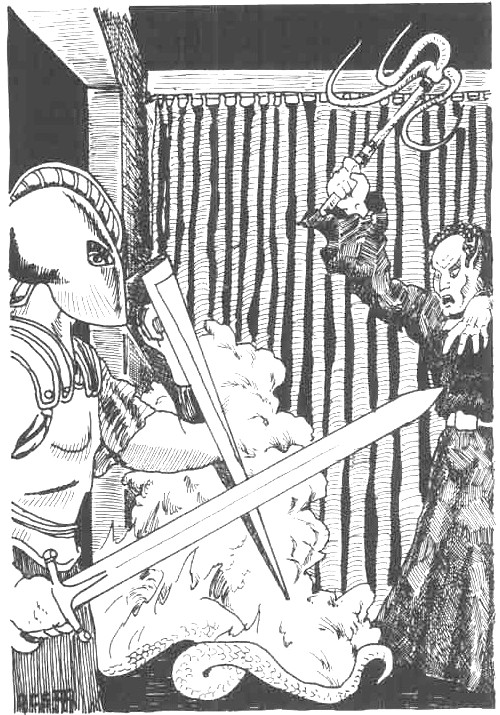
Suddenly, two shapes on the ceiling start to form. Dropping down before you reveals two gruesome Troglodytes! The foul creatures charge at you, surprising you with their assault!

Surprise is 1d6: 1, Initiative is 1d6: 1

Round 1!
The party is surprised, and will go last (for the rest of the battle)!
• An odious Troglodyte slashes at SWALKHI (2d6-2: 4) with its claws, slashing him for (1d6-1: 0) damage! [No damage, but the scrape may become infected if a barber-surgeon doesn't tend to it soon.]
• A toothy Troglodyte snaps at DONIVAN (2d6-2: 8) with its maw, but gnaws futily at his leather jerkin!

The PC's may now act...


SCUNTHORPE lets out an audible shriek at the appearance, and appears stunned for a moment. Fortunately for him, his retainers are quick to act.
ZUGG throws a dart at the odious Troglodyte (2d6-1: 9), which slides off the creature's slimy scales!
ZOTT slashes at the toothy Troglodyte (2d6-1: 7), but is repelled by the creatures foul stench!
EVANDER backs up his friend and attacks the toothy one (2d6-1: 7), but jabs ineffectively at the creature's spongy carapace!
---i don't know what weapons they carry, could you please put in the rolls for me? [They are spearmen, if I recall.]

TOECUTTER shoves past the mage and bashes the odious Trog [2d6: 8], but the attack bounces of the creatures lumpy hide!

Round 2!
• An odious Troglodyte turns on ZOTT, slashing at him (2d6-2: 8) with its claws, but is parried by the able spearmen.
• A toothy Troglodyte charges at ZUGG, snapping at him (2d6-2: 3) and sinking its fangs into the Neanderthal for (1d6-1: 5) damage! ZUGG goes down!

The PC's may now act...


Annoyed, TOECUTTER strikes the odious trog again [2d6: 9], grazing the Troglodytes bulbous shoulder ineffectually.

SCUNTHORPE tells his men to "Hold Fast!" ZOTT obeys and strikes at the toothy Troglodyte (2d6-1: 9), as does EVANDER (2d6-1: 9), but are repulsed by the monster's stench!

Round 3!
• An odious Troglodyte claws at ZOTT (2d6-2: 5), connecting with his neck for (1d6-1: 1) damage! Blood sprays out of the poor hireling's neck as he hits the ground unconscious!
• A toothy Troglodyte advances on EVANDER, flailing with its razor sharp talons (2d6-2: 2) and howling madly. The young spearmen is caught across the chest for (1d6-1: 4) damage, and falls to the ground unconscious!

The PC's may now act...


SCUNTHORPE firmly grips his staff with both hands, and swings it at the toothy Troglodyte (2d6: 10), who easily avoids it. He calls out to TOECUTTER, "The wand! Use the wand!"

"The wot?" (Yep, the mage is bonkers!) TOECUTTER swings yet again at the odious trog [2d6: 7], but is driven back by the creature's fetor! [Time for a plan B, I think!]

Round 4!
• An odious Troglodyte turns on DONIVAN (2d6-2: 0), sinking his fangs into the little halfling's backpack for (1d6-1: 0) damage! [The Troglodyte looks surprised to not have delicious halfling flesh in his gullet, as the contents of DONIVAN's pack start to spill out over the floor.]
• A toothy Troglodyte claws at SWALKHI (2d6-2: 8), but is parried by the able dwarf!
• An iron spike falls out of DONIVAN's backpack onto the floor!

The PC's may now act...


"The gnarled stick you found in the barrel of apples. Me thinks it's a magic item," SCUNTHORPE replies as he swings wildly with his staff (2d6: 10), easily missing the toothy Troglodyte.

"Yer daft - 'at's a backscratcher if I ever saw one!" TOECUTTER clubs the odious trog [2d6: 4] for [1d6: 3] damage, and maneuvers to fall back next round! The creature is momentarily dazed by the blow, but comes to and continues its attack.

Round 5!
• An odious Troglodyte turns instead against TOECUTTER (2d6-2: 6), raking its claws across his armour.
• A toothy Troglodyte continues his assault on SWALKHI (2d6-2: 4), grabbing his shoulders and chomping into his head for (1d6-1: 1) damage!

The PC's may now act...


"Ugh. Dwarves!" SCUNTHORPE explains in exasperation as he looks over his fallen retinue and strikes out at the toothy Troglodye with his staff (2d6: 7), but swings wide!

"RIGHT! Get off tha li'l one, ya git!" TOECUTTER tries to distract toothy troglodyte with a blow to the melon [2d6: 3] for [1d6: 5] damage, buying time for SWALKHI to get out of the way! TOECUTTER's cudgel bashes the slimy lizard's noggin in, causing its rubbery hide to collapse to the cave floor with a wobble! (BAM!!! -J) [Bam indeed!]

Round 5!
An odious Troglodyte looks in shock at its fallen submissive (2d6: 5) and howls in primal rage at TOECUTTER!

• An odious Troglodyte claws at TOECUTTER (2d6-2: 3), but is desperately held at bay by TOECUTTER's shield!

The PC's may now act...


TOECUTTER grins ferally and counterattacks [2d6: 7], but his swing is batted aside by the furious Trog. [Should I wait a little more for Scunthorpe?]

SCUNTHORPE jabs at the remaining Troglodyte ineffectively with his staff (2d6: 9).

Round 6!
• An odious Troglodyte continues to claw futily at TOECUTTER (2d6-2: 5) from behind his shield.

The PC's may now act...


"Offa my kit!!!" TOECUTTER bashes the trog with his shield edge [2d6: 5] for [1d6: 4] damage! The odious Troglodyte takes the shield-bash in its maw, stumbling back with fewer teeth before collapsing to the ground unconscious.

SCUNTHORPE flails at the Troglodyte with his staff (2d6: 11), but swings wide as the creature staggers back and falls.

The enemy has been defeated! The PC's may now bind other characters' wounds (restoring d6-1 hits, once per injured person), explore the room further or otherwise act.
• TOECUTTER gains 400 xp!


SCUNTHORPE , although unharmed from the battle, looks quite dejected at the cost of it. He kneels by each of his fallen retinue one by one, to bind their wounds. First ZUGG for 1d6: 4, then ZOTT for 1d6: 3, and finally EVANDER, healing him for 1d6: 2. (oops, forgot about the -1. it is corrected on their character sheets)

SCUNTHORPE then turns his attention to the fallen foes, searching them over thoroughly.

The Troglodytes have nothing but slime and offal on them. The brained Troglodyte is quite dead, but the odious Troglodyte is still breathing.

TOECUTTER pokes his head (and torch) into the opening to the east, hoping for a better view.

The light from the torch reflects off a thick fog in the eastern chamber. The party will have to effect ingress to establish a more accurate survey.

"Hey, fellow," SCUNTHORPE says to TOECUTTER, "if your aim is not to use that back-scratcher, as you call it, perhaps you would care to sell it. Name your price."

Tuesday, May 21, 2013

The Thieves' Guilds of Minaria

The poor thief has been the subject of many debates and contentions since his incipient introduction in Supplement I: Greyhawk. The most common complaint falls upon the low starting ability of the thief class. It is true, with most special abilities starting at 10% to 15% chance of success, the thief can hardly feel "special," but is instead discouraged from risking his neck on his dubious skill set. In fact, these scores only improve to an even 50% somewhere around 7th level in most editions of Dungeons & Dragons, when the thief's fighter and magic-user compatriots are well on their way to obtaining the defining features of those classes. The other common grievance is that the thief class is either unnecessary or even inimical to a proper Dungeons & Dragons play experience. When the thief was introduced to Original Dungeons & Dragons, he largely co-opted and made exclusive certain adventuring abilities that all dungeon-delvers had previously shared. Common skills such as climbing, trap-finding and lock-picking were suddenly the sole prerogative of the doughty thief, who seemingly had no other function in the game than to encompass all of the competencies once enjoyed by the original adventurers. Instead of stealing treasure, thieves had stolen adventuring proficiency from the other characters.

Feeling the acute loss of fundamental dungeoneering capabilities, some referees qualified these "new" thief skills with the superlative: as Robert Fisher suggests, perhaps all classes can move quietly, but only thieves can move utterly silently. Yet, this approach does not address basic skills like lock-picking or trap-finding—talents that adventurers previously benefited from but were now bereft of. It also did not confront the relatively low chances of success of novice thieves, which rendered their skills prohibitively futile. Other house rules diminished the great difficulty of these dice rolls by granting significant bonuses for easier challenges—a rusted lock or a crude trap door, perhaps. This latter method only solved the clumsy low-level thief by effectively ignoring the rulebook, creating a balanced skill progression where a thief always faced challenges relative to his skill and therefore had comparable chances of success regardless of level (perhaps the very antithesis of early Dungeons & Dragons).

So what is to be done about these dual problems—the loss of common adventuring abilities from other characters and the relatively ineffective ability of the low-level thief? In Minaria, thieves are a vital part of the party, and any party that enters the dungeon without at least one or two in tow is in severe danger. Of course, any character has the same ability to explore the tricks and traps of the mythic underworld—I listen to their descriptions, look at their character sheet and then let them try their luck on a single polyhedral die (perhaps 3 in 8, or 5 in 12, or 2 in 6 and so on). I will even let the player pick her favorite lucky die and then adjudicate the odds for that die type. This approach demands that the referee give a clear description of the terrain and the player gives a clear description of her action, but this action is open to any and all characters (thieves included). However, if the players cannot figure out the trap by asking questions, or if they get a close guess but botch the roll, only the thief has a second layer of defense. Here, the thief's training and skill competency kicks in, and after failing the earlier attempt the thief can make a free, back-up saving roll on the Thieves' Abilities table. These bonus odds are on top of the regular effort, and are a second chance that can rescue the party regardless of whether they have figured out the trap. Played a different way, the party can skip the initial roleplaying and just have the thief roll the ability check. If this is successful, the trap is automatically described and bypassed and the adventure continues without pause. If this fails, the party must take a closer look at the trap and roleplay their attempt to manually disarm it.

At later levels, when thief skills become very high, it is likely the party will increasingly rely on the latter method—making initial recourse to the thief skill to see if the roleplay element can be dispensed with and more exciting parts of the dungeon can be accessed more quickly. At earlier levels, however, the party will enjoy the grittiness of dealing with traps and tricks more directly. Still, all characters should have a chance to open locks, remove traps, pick pockets, move silently, climb sheer surfaces and hide in shadows, at least when they describe a reasonable strategy and have character scores to support it. When the dice turn against such dungeon-delvers, however, thieves have a second chance to catch their fall. Sometimes, the narrated attempt will be unreasonable, and the referee will simply have to say No. Even when such practical constraints limit normal classes, though, thieves should still get their chance to snatch victory from defeat. By allowing thief skills to operate like an extra safety net for dashing heroics, thief characters are encouraged, not discouraged, from using their abilities.

Wednesday, May 15, 2013

Return to Castle Frobozz, Part I

Perusing the archives of Erelhei Cinlu today, I have discovered that the reports on the death of one of my online campaigns have been greatly exaggerated! So as to share these broken fragments with the wider readership, I have elected to publish them here. They will not always make perfect sense, mind you—there are certainly pieces missing from the puzzle. But with a bit of imagination, one should be able to trace the tale of these doomed underground intruders. So begins...

RETURN TO CASTLE FROBOZZ, CHAPTER I
PROLOGUE
And so our story begins with the two dusty pilgrims, Pavel and Winfred, huddled in the dark corner of the Outs Inn of Greyhawk, early one autumn morning. Faces beset with dark looks, the wayfarers glower down into their cold, greasy gruel. They are alone in the tavern this morning - a silent ceasefire exists between them which has even scared off the normally jovial Hrothgar from his perennial post at the bar.

Oh what cruel fate! Only a couple days ago, the travelers were finishing the last leg of what had been a lovely pilgrimage. Certainly the ancient ruins had their distinctive allure, and all had looked forward keenly to seeing the fabled walls of Greyhawk - rumored to be the oldest settlement in the Known World, and once the high seat of the famed Emperor Ygg Son-of-Arne. But it was the company these two grim wanderers now mourned; had it only been two days since seeing that bright gem, Princess Velouria?

Certainly the motley group of pilgrims found it unconventional to be accompanied by such royalty at first, but soon the young and beautiful princess had won each and every traveller's heart with her peerless melodious singing and other winsome affections. By the end of the journey, the troupe had already begun to set upon each other with challenges and dares to prove themselves before her lashful eyes.

But tragedy struck that final night, just shy of the gates of Greyhawk, when a mysterious figure attacked the caravan. Clad all in black, the transgressor knight, who went only by the moniker "The Dark Lord", defeated the tourists one by one, until only he remained standing. Sweeping up the princess from the bed of daffodils she had daintily feinted into, the Dark Lord gave the woe smitten party one more severe reproach before vanishing in a puff of smoke.

Two days later, all that remained of the band now sat mutely in this bar; the hours of quarreling and lamenting long since passed. Of the other companions, some had gone mad with distress and dispersed in random directions, while still others had vowed to rescue the fair maiden and headed up the thick forested mountain towards the mysterious fog-decked Castle Frobozz, which the Dark Lord had indicated was his home. Of this last group, none had returned and, by all legends of the Castle, no return should be expected either.

Perhaps all is lost, and there is nothing left but to return home in shame. Surely, the chance for adventure, reward and glory is behind you now, and even worse - a chance at the fair damsel's hand! But what is this note here, stamped in a strange seal, that flutters lightly on the table? Was that here when you came down this morning? Has it always been here?


THE OUTS INN
Of all the establishments in Greyhawk, the Outs Inn is notable for achieving the most impressive amount of grim and dreck. Normally deserted, this dilapidated watering hole would be considered abandoned if not for the stalwart presence of its owner, Hrothgar the Dwarf. Despite the bleak setting, the curious creature is surprisingly friendly and outgoing, and happily welcomes you to "the finest" (and, indeed, only) "tavern outside the city walls!"

Exits are UP or OUT.

There is a NOTE here, there is a HROTHGAR here.

PAVEL stops a moment from eating his slop. He notices the note. He notices WINFRED noticing the note. He tries to grab it first.

WINFRED groggily rubs his eyes, trying to shake the effects of the previous night's ales. He notices a note on the table and wonders if perhaps it was misplaced and there would be a reward for its delivery. He looks to his coin purse, noting he has only four gold remaining. In the moment of distraction PAVEL grabs the note.

Admiring the strange seal once more, PAVEL notices the stylistic "A", embossed in the shape of a warped star with a flaming pillar in the middle. Breaking open the parchment causes the seal to crumble into several pieces. Within is a short poem followed by a crudely drawn map:

"The fog recedes,
the true treasure of the dungeon,
it is yet to be won,
to it a winding path leads…"

The map roughly shows an ascent up the eastern side of the mountain, upon which sits the gloomy Castle Frobozz from which none return. The path stops halfway up the mountain at a circular symbol.


WINFRED looks up at the sound of the seal on the note being broken. “Friend Pavel,” he begins, craning his neck to get a look at the note, “ the unfortunate events that have transpired on this pilgrimage have clearly worn on us both. Let us start our friendship anew with the search for... whatever it is that note you have here is about. Two honorable men such as ourselves traveling together shall surely overcome challenges that one alone could not.”

PAVEL gazes across the horizon of the letter at his friend. It's a cold stare. He glances down at the letter, "You better take a look at this then," he says tossing the letter across the table. Scowling, he heaves some slop into his mouth and continues with his breakfast.

WINFRED looks the note over. "Strange," he mutters. "Hrothgar, did you by chance see who left this note here?"

Having failed at being inconspicuous, the wrinkly dwarf looks up from his work of wiping down a single swath of the otherwise grimy bar.

"Nae, boppins!" he replies, before hopping down from his stool. You trace the peak of his bent felt cap bobbing behind the bar until the puppet finally appears around the side. He pads up to the table, bells clinking on his soft shoes, draws close and palms the note in his stubby fingers. You can't help but notice that the foul homunculi stinks worse than the docks on Yob's Day, a festival dedicated to the rotten fish-god worshipped by the inbred peasants of this area.

Pulling out a pair of (likely pilfered) spectacles, HROTHGAR pretends to read meaningfully for a moment, before his beady eyes settle on the crudely drawn map and grow wide with fear.

"Well ta first part is a recipe, methinks. Yep, butter'd chicken." it says, licking its slimy lips. "But ta second part, that'd be a map of the Castle Frobz. No'uns ever come back from that fog I tell you! It eats men alive! If only for a chance at the castle gates, the treasures indwelled are said to be beyond imagination!"

The scurrilous tramp goes on to do what dwarves perhaps do best, and tells a mesmerizing tale of spectacular riches and wealth that would make a sultan swoon; seas of golden coin, ruby encrusted pillars, the finest jewelry and ornaments and priceless works of art abound. Half the morning must have passed before you snap out of the charm (coins still dancing in your mind); the drizzly weather outside gives no indication, but you can judge the lapse by your gruel, which has separated into thin tinny water with fatty solids that float near the top. Your stomach grumbles in protest, as the loathsome wretch concludes "But this I've never seen, a passage up the eastern slope? B'ware young boppins, those hills are rumored to be full of nasty warrens."

Recalling your childhood lessons that dwarves indeed live under mounds of dirt, you decide to take such a warning with some thoughtfulness.


With the conclusion of the dwarf's tale WINFRED collects his things. "Perhaps it is time we moved on Pavel," he whispers in a hushed voice, "I doubt this dwarf will be of any help."

WINFRED goes OUT and takes a look around.

PAVEL nods, "I will be needing some supplies I suppose. We may also want to recruit a peasant to carry our goods and absorb any arrows destined for our chests." He gets up from his table, leaving a few coppers on the table and follows WINFRED OUT.

As the PAVEL exits, HROTHGAR pads up to him and stuffs a small, leather bag into his hands. "If ye are thinkin' of going to Frobz, take this, I beg ye! Me mutter told me to use it if I ever came across a deep creature; but dun'nae use it on anything else! Only the deep ones!" Opening the pouch reveals a handful of granola.

PAVEL appreciates the gesture and nods to HROTHGAR on his way out.

Waiting until PAVEL and WINFRED have left, SCUNTHORPE approaches HROTHGAR, and says "A couple more pints for me and my friend," pointing to SWALKHI in the corner. "You've got a fine establishment here."

SWALKHI walks up to HROTHGAR and SCUNTHORPE. "Aye, sir -- good to see a brother dwarf with his own establishment in such a far flung land. Are there more of our folk hereab

MUDDY LANE
The road here is well worked by wagon wheel and foot traffic alike, so that deep ruts have formed in the slop and filled with the morning's rain. This is western road that leads from Greyhawk out to the lands of Westmark. Before you stands the shabby Outs Inn, run down from years of neglect. To your EAST lies the Western Gate of Greyhawk. To the NORTHWEST, the road climbs up into the thick pine forests and disappears around bends in the brambles.

Exits are IN, EAST or NORTHWEST.

There is a SIGN here, there is a GROUP of MERCENARIES here, there is a CONDOTTIERE here.

PAVEL nods to the MERCENARIES, tipping his hat to them as he approaches.

"Allo guv'nah!" the broad mustachioed CONDOTTIERE says, stepping forward and pumping PAVEL's hand mercilessly. "My Landsers are the best in the business! We've just come arrived with the caravans from Westmark. The pikes of the Black Band are the sharpest in the Known World, and for a modest fee they can shore up your battle lines!"

WINFRED reads the sign.

The sign reads: "EAST - CITY of GREYHAWK, NORTHWEST - WESTMARK ROAD and OLD CASTLE TRACK"

WINFRED turns from the sign and approaches the MERCENARIES as well. "So my good man, how much is it to hire one of your pikes?"

"Merely 5 coin a delve or per week, whichever comes first! Payable in full ahead of time to my persons, of course," replies the CONDOTTIERE.

"Are they hardy men for that price?" asks PAVEL. "We're going to the castle Frobozz. We don't want no turn-coats adventuring with us."

"These lads are Westmarks finest!" cries the CONDOTTIERE, "I haven't heard of this Castle Frobozz, but I can attest no member of the Black Band has ever turned heel while their charismatic captain still stands. Treat them well, pay me promptly, and you can be assured of their service."

WINFRED turns to talk to PAVEL out of earshot of the mercenaries. "I am willing to hire one of them, or rather I would be if I weren't so short on gold at the moment," he says looking slightly embarrassed. "I you could lend me a gold coin I will gladly repay it at the first opportunity. If there's even a fraction of the treasure HROTHGAR claims we'll need help to carry it all."

PAVEL waves off WINFRED's concerns. "It is of no consequence, friend. I was planning on hiring two or three. Three would leave me tight to purchase rations for the journey."

"Hire however many you feel would work best, PAVEL. You will be reimbursed for your trouble from the treasure." WINFRED purchases 4 days rations.

PAVEL returns to the CONDOTTIERE and requests the services of three mercenaries, and is granted the service of young AUGUST, ZOTT and EVANDER. PAVEL purchases 10 days worth of dried trail rations for the road. "I believe we have what we need. Unless there is anything else that you require, WINFRED, I suggest we make haste."

WINFRED finishes his purchases. "I'm ready when you are."

PAVEL nods and leaves NORTHWEST with WINFRED.

FOREST ROAD
The thick pine trees converge on the Westmark Road here, veiling the way in an eery silence and gloom. Down the hill to the EAST, the rotting patched roof of the Outs Inn is visible; a thin silvery line of smoke drifting lazily from its badly leaning brick chimney. Beyond that, the grand City of Greyhawk unfolds on the narrow escarpment overlooking the wind licked Great Sea.

To the WEST, the road continues deeper through the forested hills to the sundry counties of Westmark. To the NORTH, the crumbling remnants of a decrepit bridgehead over a small stream mark the beginnings of the Old Castle Track which leads to the haunted Castle Frobozz. A menacing fog looms that way. To the NORTHEAST, a barely noticeable deer path leeds across the stream and around the eastern face of the mountainside.


Exits are NORTH, NORTHEAST, EAST and WEST.

PAVEL remembers the map and points out the deer path. "I believe that is the direction we want to go."

WINFRED also remembers the map. "Yes, I do believe you are correct, PAVEL."

PAVEL heads towards the deer path, leaving NORTHEAST.

WINDSWEPT BLUFF
The forested mountainside tumbles down into a sheer precipice here, dropping hundreds of feet into a distant estuary below. An old deer trail clings tenuously to the fringe of the rocky crag, leading SOUTHWEST down the face of the mountain or ascending WEST directly up the heavily forested slope. From this vantage point, the eastern ends of the Known World open up before you, revealing distant squalls out at sea and the wooded wilderness of the mountainous Eastmark seaboard.

Exits are SOUTHWEST or WEST.

PAVEL goes WEST.

UNKNOWN GROTTO
A small grotto cuts into the mountainside here; a low entrance leading down into the darkness of the earth. Before the portal, a small dragon is curled up on a pile of dirt, leaves and bones. The glint of tarnished golden treasures gleam dimly from the refuse. There is an air of melancholy here. An old deer path leads EAST down the mountainside. To all sides, the menacing fog looms, yet strangely does not reach the trail or cavern opening.

Exits are IN or EAST.

There is a DRAGON here, there is a TREASURE HOARD here, there is a DONIVAN here.

PAVEL halts and raises his fist above his head, signaling everyone to be silent. He waves over WINFRED and points to the DRAGON. Carefully, PAVEL whispers into WINFRED's ear, "Know ye much about dragons, friend? This looks to be the route by which the map wishes us to enter the castle."

WINFRED nods. "Lets try to get by as silently as possible."

Approaching the dragon reveals that the wyrm is apparently midst forty winks, and slumbers peacefully on its precious take. It is a lissome creature, with slender features covered in brilliant emerald scales, perhaps the weight of a horse and some half dozen paces long from nose to tail's tip.

DONIVAN peers out from the underbrush at the two adventurers he has been following since he overheard them talking of treasure while hiring mercenaries near the city gates.

[Assuming Pavel and Winfred continue past the dragon down into the earth, follow below. Otherwise, continue here as normal.]

LOW CAVERN
It is pitch black. You are likely to be eaten by a grue.

There is a PAVEL and a WINFRED here.

PAVEL takes out a torch and his flint and steel from his back-back. He lights the torch, being mindful to keep an eye over his shoulder towards the direction of the dragon.

To Be Continued...

Thursday, July 12, 2012

Every Fighting-Man is Unique

I am not aware when it came about, but at some point a vicious rumour crept into our collective understanding of Dungeons & Dragons. This rumour subtly, surreptitiously put forth the notion that the original game, in its basic, open-ended template form, was somehow too limited. There weren't enough monsters, there weren't enough classes, there weren't enough powers or abilities. The original game, so this shadowy speculation would have you believe, just didn't have enough stuff.

So the next generation of more "advanced" games came out, promising more things for the throngs of adventure-hungry players to do by promising game rules that were packed with more stuff. Ironically, on the other end of this history (some thirty years later), we are now flooded with such games—enough to stack from floor to ceiling in a dusty, unvisited brick-and-mortar gaming store. We certainly have enough adventure, yet, we have very few players hungry for adventure. What went wrong? What was it that originally enchanted those players, who came from every walk of life, and made them so esurient?

Today's games have naturally attracted a very different, and far less diverse crowd (which is unfortunate, not only because we lose perspective and creativity, but because many of the so-called "gamers" are individuals that no one in their right mind would like to spend an afternoon with). The excessive influx of systems, mechanics and rules to our Saturday afternoon scenarios naturally caters to rules-obsessed types, and the move away from free-form, communal decision-making and storytelling alienates people who didn't sign up for this level of commitment. But there is also a delightful agility that was somehow lost in this sad transmutation.

I believe that earlier adventuring aficionados truly understood that the original game was merely a template. The apparent limitation, for example, to choose one of three iconic character options (Fighting-Man, Magic-User or Cleric) belies the fact that these choices were never meant as more than basic blueprints from which characters were built. Looking in the three little books, for instance, one finds extremely few limitations: ability scores have next to no impact on the game, the rules allow dual and multi-classing, and any character can attempt any action. There was essentially an adventurer, and different options determined what access he or she had to different equipment and spellcraft.

One of the rarely highlighted aspects of the original game in particular is the concept of level titles. This dizzying array of honorifics is typically understood as a strict progression, one to the next, so that a Hero becomes a Swashbuckler or a Sorcerer becomes a Necromancer or a Bishop becomes a Lama. Yet, as we can see, this progression is not altogether coherent (why should a Catholic Bishop become a Tibetan Lama, exactly?), which may have led many to simply discard level titles entirely. At my table, I encourage my players to really make level titles their own, however, and use them to define their characters.

Maybe Toki, a Japanese Fighting-Man character, starts off as a Veteran. By level two, I encourage him to describe how his Fighting-Man is different, and soon he takes the level two title "Sohei" (or warrior monk, becoming an ascetic mountain warrior). During level two, I allow him to track monsters through the woods or navigate untamed mountains. By level three, the campaign has taken another turn: Toki takes on the role of a pirate and starts swinging from ropes and intimidating his opponents.

Customizing level titles is an excellent way to show your players that the archetypal classes are merely base templates from which characters are developed. I do not believe a party with 14 Fighting-Men should feel like a party with 14 Fighting-Men. The fact is that the Fighting-Man class, like the other classes, is broad enough to contain every sword-swinging hero one could dream up. Each character should be different and unique, and the rules of the original game are just open-ended enough to allow that. In reality, there is nothing more alienating than bringing a new player to your table and telling him that his character concept has to fit within your game's hard boundaries and strict definitions, and this is one of the main reasons that this hobby lost its diverse player community: we stopped asking people to bring their own creativity and ideas to the table.

Thursday, June 21, 2012

What is a Setting?

Campaign settings have always held a rather schizophrenic place in this hobby. The first settings, Blackmoor and Greyhawk, were merely the dungeon and the environs around it, extending further only rarely, as the adventurers pursued other plots (and then collapsing back to the central dungeon when new players came in). A great example of this are the adventures of Robliar, Tenser and Erac, who dropped through the chute to China in the ruined pile of Greyhawk Castle, only to adventure back to the other side of the world, drawn like a magnet to the tentpole of the campaign. Other campaign events created new areas, such as the domain of Iuz (a foe who was originally released from the dungeons of Greyhawk), yet these new area always deferred to the original environs (with no sustained campaigning in the new regions).

Yet, when TSR took off, it became profitable to publish fully detailed and designed campaign backdrops. World maps were drawn up for the first time ever, and the local environs around Castle Greyhawk became the "World of Greyhawk" (true, the original Greyhawk was situated on the C&C Society map, but the extent of this map is unknown and apparently not well developed). With published settings, the concept of a campaign backdrop turned from the small, local region to the internation and global scene.

Still, I suspect, most referees ended up designing their own settings for their home campaigns, much like Arneson and Gygax themselves had done. The natural impulse is not to delineate a sweeping world, painting with a broad brush, but rather to go ever smaller, refining the details and going deeper into the very concept of the setting. The former approach is geographic, and creates boundaries that delimit thought even as the "broad approach" is meant to liberate possibilities by making the world seem "big." The latter approach is conceptual, and defines the setting as an idea, not a fixed and stale cartography where the possibility for new events must be fit into a pre-existing framework. They are fundamentally different approaches, one structural and the other theoretical, that produce very different experiences for the referee (and we must remember that the referee is a player too, and that campaign preparation is part of the game).

Interestingly, it was setting stagnation (and setting over-definition), that first drove Arneson to boredom with Braunstein, leading him to create Blackmoor. The Napoleonic scenario had been fully described and defined, and the possibilities exhausted, by a structural approach to the scenario that put characters in relation to each other like chess pieces. Instead of focusing on the politics of the scenario, however, Blackmoor focused on the root inspiration at the core of the setting. As the DCC rulebook says:

"Make your world mysterious by making it small—very small. What lies past the next valley? None can be sure. When a five-mile journey becomes an adventure, you'll have succeeded in bringing life to your world." (Dungeon Crawl Classics Roleplaying Game, page 314)

Here, the sage advice to "think local" should be paired with a conceptual approach to campaign definition. There is world enough in the 50 miles around your central megadungeon: make things happen there! Festivals are thrown, distant merchants arrive, new enemies appear, alliances are struck and broken. The core concept of your campaign inspiration is often difficult to articulate, but one should not flee from this and start detailing regions that no player will likely ever see. Instead, turn back and develop that core concept more and more, mining it for new inspiration, and do not be afraid to let it change as your interests (or real events from the campaign) require. No one truly knows where such a setting will go next, yet it always feels like home.

Friday, June 15, 2012

SUPER OD&D

Marv made an interesting comparison over on the Goodman Games boards. To me, Dungeon Crawl Classics is like a Super OD&D (in the tradition of Super Mario Brothers games). Indeed, it has many similarities to the three little brown books of the original game, yet it makes thewy additions and expansions to that base as well. The first volume of that game alone shares basic assumptions about the social scale of experience levels, the power of classes, the protected niches of characters, the nature of magic.

Take magic, for example. Via Chainmail, the magic system in the original game is highly unpredictable, where magic-users can cast a spell only to find their spell miscast without benefit (and lost), cast successfully (and retained for future use) or caught somewhere in between, in limbo until the next turn. DCC takes this basic principle and adds much more detail, so that miscast spells might also transform the caster into a hideous creature, or successful sorcery might prove unexpectedly powerful. Add in supernatural patrons and character-specific spell manifestations and you have a magic system that is built from the same basic foundation as OD&D, yet with much more muscle to it.

Similarly, the progression of power for fighting-men is modelled directly on OD&D. While later "advanced" editions of the game weakened the fighter, introducing the "linear fighter, quadratic wizard" quandry, it is important to remember that this problem is entirely foreign to the original three little booklets. A ninth level fighting-man was simply nine times more powerful than when he first started out (similarly so for magic-users). He fought as nine men, with nine attacks (each the strength of one man's strike). While his "advanced" cousing, the fighter of AD&D was reduced to two or three attacks a round, the DCC warrior returns to native soil in a unique way, making three attacks, each strike the strength of three men (for identical output to the OD&D fighting-man, but with less dicing). Add in critical hit charts, fumbles and mighty deeds, and again you have a robust and powerful addition to the original game.

Even the social scale of characters in DCC is reminiscent of the original game, where a first level warrior is no mere soldier. Roughly speaking, a first level character is already the hero of the townships, an unlikely local that rose to unexpected prominence for his deeds. His tales will be told in the few villages of the valley for several generations. A level two character is the celebrity of a major city, well known by all but the unsophisticated. By third level, an adventurer has already rose to the prestige of a conqueror-king or slayer, whose legend will endure. This is far removed from the scale of power in later games, but is actually perfectly in line with the concepts found in OD&D.

More comparisons can, of course, be drawn with the other volumes, but this is just what comes to mind while paging through Men & Magic. I am curious how this plays out over longterm play, but I suspect the pace and style of DCC would be very reminiscent of the original three little books. Of course, it was always a design goal of DCC, it seems, to start at 1974, but only go backwards from there, instead of forward into the future.

Monday, October 25, 2010

Height, Weight and Plate Armour

I have always struggled with how best to prevent character inheritance from spoiling the balance of my campaigns. This is brought into special relief by plate armour, which I give to newly rolled up Fighting-Men for cheap (50 coins, as per Men & Magic) and then sell for a much steeper price in the marketplaces of the campaign world. My reasoning is as follows: new warriors should already come equipped with the critical boost of plate armour, but such a powerful resource should be a pricy upgrade for later characters and henchmen. Yet at gaming tables as deadly as mine, those plucky warriors do end up dying, thus leaving their priceless plate for the rest of the party's malfeasance.

Plate armour, of course, is the nicest thing a low-level party has to inherit. At higher levels, inheritance does not cause such imbalance problems in my experience, so I can happily focus my efforts on the specific problem of plate armour. Loathe as I am to import overly artificial or contrived constraints on our favorite numeral three armour class, we must look to the particularities of the historical suit of full plate.

What immediately stands out is that, more so than any other piece of armour (let alone equipment), plate armour is custom tailored to its owner. Here, the height and weight of the wearer are of principle importance. Not only does transferring the suit to a new owner entail a thorough scrubbing to remove any remnants, but the body type of the new ward must be similar enough to the former, lest the suit require an extensive retooling to properly balance and fit comfortably. We must therefore provide a method to determine the height and weight of characters in OD&D. And Lo!;

Height
Human: 5 feet*
Elf: 4 feet*
Dwarf/Hobbit: 3 feet*
*Add 3d6 inches for males or 2d6 inches for females.

Weight
1 Stone per foot (rounded) + 2d6 (average build) or + 1d6 (slim) or + 3d6 (heavy)

For the uninitiated, this results in an average male hero of 5'11" and 182 lbs. If the dispossessed and the new owner are within 3" of height and 3 stone of weight, the inherited armour can be worn without difficulty. Otherwise, the armour must be retooled - to the price of a new suit of armour!

Thursday, July 22, 2010

The Sage

Here is my final optional class for pulpy campaigns: the sage. Also, check out the wanderer and the rogue if you missed them.

Sages: Living on the very border of civilization and wilderness, the reclusive sage is a lifelong student of ancient lore. These eremites have unlocked the secrets of the empyrean and learned how to transcribe both arcane and divine magic into precise formulas. Sages prepare and cast spells exactly as a magic-user and they may also transcribe cleric spells into their spellbook, although due to their peculiar celestial equations they cannot prepare the same spell more than once at a time. Sages have the same restrictions on equipment and magical items as magic-users, but are far more bookish and will only pick up and use a weapon or magic item when pressed by immediate and dire necessity. Otherwise, sages fight, save and require the same number of experience points for each level as magic-users do. Additionally, sages have a superior ability to know fragments of ancient lore, and any elaborations a sage makes on such a piece of knowledge has a chance of being fairly accurate.

Dice for Acc Fighting Spells & Levels
Sages umulated Hit Capability 1 2 3 4 5 6
Recluse 1 Man - - - - - -
Hermit 1 + 1 Man + 1 1 - - - - -
Hedge Wizard 2 2 Men 2 - - - - -
Wise Man 2 + 1 2 Men + 1 2 1 - - - -
Shaman 3 3 Men 2 2 - - - -
Savant 3 + 1 3 Men + 1 2 2 1 1 - -
Augur 4 Hero - 1 2 2 2 1 1 -
Scholar 5 Hero 2 2 2 2 2 -
Magus 6 + 1 Hero + 1 3 3 3 2 2 -
Philosopher 7 Wizard 3 3 3 3 3 -
Sage 8 + 1 Wizard 4 4 4 3 3 -

Monday, July 19, 2010

Referee Screen

Here is another little freebie for the readers. I couldn't find a good referee's screen that used Chainmail, so I quickly threw one together. The intended layout has the Underworld and Wilderness section as the leftmost pane, the Chainmail tables in the center and the list of monsters on the right. I tried to include only information that would be relevant during a game, so I left out dungeon design notes, treasure tables and so on. Let me know what you think.

Referee Screen for Dungeons & Dragons

Thursday, July 15, 2010

Reavers from the Wastelands

The original world, tucked away and hidden in the white box, is one of fierce nomadic bands of humans and humanoids that scour the badlands. Why should we think this, when every later edition of the game has portrayed a very different, more civilized setting? A quick look at Volume II gives us our first clues to this barbaric backdrop.

Unlike their later counterparts, original heroes could expect to meet wandering groups of several hundred men and humanoids in the wilderness. Large mobs of humans, in particular, are some of the most common outdoor encounters. This is particularly interesting, given the relatively low numbers of settled communities on the default wilderness map. As others have noted before, the three little brown booklets expected the referee to use Avalon Hill's Outdoor Survival board game for all wilderness adventures, just as much as referee was intended to use Chainmail for combat encounters. Volume III finally gave a scale to this map ("the greatest distance across a hex is about 5 miles", pg 17), meaning each hex represented just over 16 square miles, and the total outdoor map represented 23,740 square miles (or just about the size of West Virginia). It is perhaps surprising that such a massive country has only 9 towns and 26 castles.

Furthermore, we can use the rules for clearing a barony of monsters to determine the average wilderness population of the Outdoor Survival map. In the 1,462 hexes, 601 are clearings, 395 woods, 98 rivers, 36 swamps, 254 mountains and 78 are deserts. By terrain type and encounter odds, this indicates the whole map contains an average of 44 large hordes of men and 41 small parties of heroes. Of the hordes, about 17 are bandits, 12 brigands, 7 nomads, 6 berserkers, 2 dervishes, 2 cavemen, 1 buccaneer and 1 group of river pirates. The heroic parties are equal numbers of fighting-men, clerics and magic-users with an average of 8 individuals per party. All told, this indicates there are 7,588 men roaming the countryside. With only 9 villages on the map, this indicates there are about 843 outcasts per village, which has to be a significant percentage of the total population (if each is a town of 2,500, as S. John Ross suggests, this means one quarter of the human population lives outside city walls).

Granted, Gygax doesn't indicate to us exactly how big each "town" (Volume III, pg 15) on the Outdoor Survival board should be, although the rules for Baronies suggest an estimate of 2,500 is probably not far off. Here, a hero that builds a stronghold is assumed to rule over a base peasantry of around 1,250 villagers in her demesne, some 20 miles distant from the keep. The population density here is about 1 head per square mile, or approximately the same population density as Alaska.

The wandering humanoid population is still significant, although surprisingly lower than the that of men. Compared to the 44 hordes of men, there are only about 6 roaming tribes of orcs (and a similar number of Kobolds, Goblins, Hobgoblins and Gnolls). The relatively lengthy ecological discussion of Orcs in Volume II indicate a possible reason for this. Most of the entry for these humanoids is devoted to their settled life, particularly the defense of their lairs. Half of those found wandering in the wilderness will be escorting wagon trains, which is perhaps evidence of mercantilism. If we assume from this that orcs are at least as settled as their human counterparts, then we can suppose the 990 orcs that wander the Outdoor Survival map are matched by another 3,000 settled orcs (2,000 of which live in caves, 1,000 in villages walled with palisade defenses).

What should we take away from these clues? A world where one quarter of the population is armed and roaming a vast wilderness has tremendous impact on all levels of society. It changes how we should understand the safety of civilization, the economic system, the power of monarchs and how power is conceived generally. With so little stability (one third of the settled populace would have to be constantly mobilized to defend the city walls), rulers would have to rely on shifting alliances with the nomads, and bids for power would likely have rare and dangerous artifacts as their prize, instead of tracts of land or natural resources. Here, the battle between Law and Chaos is sharply realized as a conflict that the forces of order are always on the brink of losing. In this way, the wilderness ecology written into the implied setting of the Original Dungeons & Dragons game tells a striking story of how the early game world might have been imagined. Considering Avalon Hill's Outdoor Survival, combined with the guidelines in Volume II and III, this setting that takes shape is radically different from how those of later official publications were conceived.


Thursday, July 8, 2010

The Mmmmmm! System

At my table, I use an informal initiative ordering system, roughly based off the simple turn sequence found in Chainmail and Swords & Spells. Both systems break the combat round down into discrete phases for movement, shooting, spells and close combat. Notably, the sequence in Chainmail provides two steps to fire missiles in the combat round, while Swords & Spells increases this to three shots per round. Yet, both of these games were intended first and foremost to represent mass battles. To portray the freedom and chaos of the small scale skirmishes typical of adventures in Dungeons & Dragons, a little more detail must be hewn from the existing systems.

My sequence, obnoxiously entitled the Mmmmmm! system, is broken down into six steps that are followed through each round of combat, as necessary. The first round of combat still starts with an initiative roll (unless one side is surprised), which is kept through the rest of combat. Each round begins with the players announcing their intended actions. The steps are as follows:


1.Missiles
2.Movement}
3.Magic} †
4.Movement} ‡
5.MĂªlĂ©e} †
6.Miscellaneous}
} = Bows/Thrown † = Light Crossbows ‡ = Heavy Crossbows

Missiles: In the Missiles step, all ballistic attacks are made (including artillery), starting with the side that has initiative. Additionally, each later phase is marked by a "Supplementary Missiles" step, according to the type of weapon (as noted above). In this way, bows fire up to six times a round, light crossbows three times, heavy crossbows twice and other weapons (like arquebuses or artillery) fire only once. The supplementary missiles step is taken immediately after resolving the main step (whether magic, mĂªlĂ©e etc.), and if a combatant takes part in the main step, she loses not only any supplementary missile attack from that segment, but also her next scheduled missile attack (whether supplementary or not).

Movement: There are two movement phases that are otherwise identical. Starting with the side that has initiative, combatants can move up to their full normal movement in each phase (12" for men, 24" for cavalry and so on).

Magic: I usually don't allow a spellcaster to move or make attacks in the same round she attempts a spell. Any damage from missiles disrupts the casting.

MĂªlĂ©e: This step uses the standard rules from Chainmail. While you are locked in mĂªlĂ©e, any non-mĂªlĂ©e action (including supplementary missile attacks, movement, spells and so on) becomes a miscellaneous action (see below).

Miscellaneous: This step is for any remnant action that requires some degree of concentration (such as helping a wounded comrade, imbibing a potion, lighting a flask of oil and so forth). Regardless, you can only perform a single miscellaneous action per round. Whether a player can perform other actions in previous steps and still act in the miscellaneous step is at the discretion of the referee, but any damage taken in mĂªlĂ©e negates the ability to use the miscellaneous step.

Wednesday, July 7, 2010

On Shields, Helmets and Mail

Enough attention has been given to weaponry lately that certainly armours deserve some like consideration. To wit, we shall casually observe some rules–old and new–for shields, helmets and mails; equipments donned by hopeful heroes seeking some protection against the monstrosities of the Underworld.

Shields
There is no need to reinvent the wheel here. With shields, we must note that the rules for Man-to-Man Combat in Chainmail allow one so furnished a superior deterrent against missile attack, particularly when combined with suits of armour. Strapping on a shield with plate armour or chain mail increases your protection against ranged weaponry by bounds (compared to the jejune static +1 of the "Alternative Combat System" found in Volume I). Alternately, we must also note that shields in Chainmail are easily obviated by particular weaponry. Battle axes have a nasty habit of cutting through such impediments, while flails can usually find their way around edge of the shield. Similarly, shields do little to absorb the weight of maces and other blunt strikes.

Regarding magical shields, it is important to recall that the armour class bonus for these items does not stack with the bonus of magical armour. Even when the shield's bonus is superior, it is only taken into account 1 in 3 times (see page 31 of Volume II). Perhaps this can be considered the same odds for the shield to catch a non-lethal projectile as well, instead of using armour class (a rotten tomato thrown by an angry peasant, for example).

If you want more cinematic shields, I recommend Trollsmyth's "Shields Shall be Splintered!" in its most basic form (i.e. mundane shields can be sacrificed to negate a hit, after the damage has been rolled). Magical shields can, perhaps, absorb a number of hits for "free" each session equal to their bonus (after which, they splinter!).

Helmets
These are included in Original Dungeons & Dragons without any explicit rules for their use. Volume II implies that magical helms are hit 10% of the time. For what it's worth, I prefer the Advanced Dungeons & Dragons rule whereby helmets are considered in the overall armour class and attackers will direct attacks against unprotected heads 1 in 6 times. If you are using Chainmail, this is easily represented by levying any attack roll that comes up doubles against the "no armour" column of the Man-to-Man Melee Table (this is also 1 in 6 times, with no particular weighting on strike probability).

Otherwise, helmets would give contextual protection against falling rocks, green slime dropping from the ceiling and so on. They should also limit vision and awareness, making such fighters easier to ambush.

Mails
Like those for helmets, the rules for armour are actually fairly scant in Original Dungeons & Dragons. Volume I implies that a more heavily armoured combatant moves more slowly (a holdover from Chainmail), although instead of using categories of armour ("Light Foot," "Heavy Foot" and "Armoured Foot"), the referee is apparently meant to use weight of equipment. To this effect, a warrior with chain mail, sword and shield could easily fall into the fastest category (12") while carrying extra gear into combat could quickly slow her down to the slower categories (9" and 6" movement a turn). Elves and Hobbits have the same 12" base movement as humans, according to Chainmail, while Dwarves halve this.

If you don't use encumbrance rules, I recommend simply allowing chain-type armour to subtract 3" from movement and plate mail to subtract 6" from movement. Either boost dwarf movement up to 9" to absorb this, or just disallow demihumans from wearing plate armour (incidentally, this is what I do in my campaigns).

In his micro-RPG inspired by OD&D, Searchers of the Unknown, Nicolas Dessaux makes armour class inversely proportional to both movement and initiative bonus. This is a clever way to truly represent how sluggish a warrior is in full armour. A simple way to represent this in Chainmail is to allow the combatant with the faster movement the title of "attacker" when two foes charge at each other. This gives the lighter-armoured opponent a little initiative in striking order, without displacing the importance of weapon class and the initiative roll.


Addendum: Movement
Many others have lamented the oddities that have always plagued movement rates in Dungeons & Dragons. For my part, I like the simplicity of converting outdoor yards to indoor feet, but Gary's figures are still quite baffling. While Volume III allows only two moves per turn (that is, 240 yards in 10 minutes), Chainmail does a little better and allows one move per round (120 yards in 1 minute). Arguably, the latter rate is still too slow, and was likely intended to account for things like keeping formation, waiting on battlefield commands and other delays that do not factor into the small scale skirmishes of man-to-man combat. In my games, I allow two moves per round (in place of, and immediately following, each missile fire). Thus, an unencumbered fighter can run (240 yards per round, or 8 miles per hour) or walk (120 yards per round, or 4 miles per hour). An encumbered Dwarf would move about a yard per second, which also seems right. This is all keeping in mind that close combat range is 3".

Friday, July 2, 2010

The Wanderer

Another optional character class for pulp swords & sorcery games, I present the wanderer.

Wanderers: Considered dangerous savages by society, wanderers hail from the utter ends of the world. These wild men have shunned the ways of civilization for the laws of the wilderness, and have learned how to survive on their own. Relying on their own prowess, wanderers are mistrustful of sorcery and may only use one magical item at a time. They may use any weaponry, but are limited from wearing armour heavier than chain mail. Due to the raw fury of their attack, wanderers gain a bonus to all damage they inflict equal to half their level rounded up. Otherwise, wanderers fight, save and require the same number of experience points for each level as fighting-men do. Wanderers have a superior ability to traverse natural obstacles, navigate difficult terrain, track enemies and survive in the wilderness.

Dice for Acc Fighting
Wanderers umulated Hits Capability
Nomad 1 + 1 Man + 1
Wild Man 2 2 Men + 1
Roamer 3 3 Men or Hero - 1
Ranger 4 Hero
Outlaw 5 + 1 Hero + 1 or 5 Men
Marauder 6 Hero + 1 or 6 Men
Outlander 7 + 1 Superhero - 1
Wanderer 8 + 2 Superhero
Barbarian King 9 + 3 Superhero + 1
Barbarian King, 10th Level 10 + 1 Superhero + 1

Monday, June 28, 2010

Spears & Swords in Chainmail

After a quiet May, chipping away at my Master's Thesis, I finally have a breather to talk shop again. I just want to briefly address the noble spear and sword, two ancient and remarkably versatile weapons that perhaps don't get all the respect they deserve in Chainmail.

The spear holds esteem as being the most ancient of elegant weapons - a simple design that invites a profound depth of mastery. Others have bewailed the poor sorts the spear has been dealt before. Indeed, a weapon that E.O. seemed to favor in his art has generally been relegated in Dungeons & Dragons to dealing less damage than the competition, with no advantage granted for its superior length and versatility.

Yet, Chainmail presents much more detailed rules for individual weapon types, and should more than account for the different strengths and weaknesses of each armament. The spear's high weapon class of 8 certainly allows it to strike first against a majority of weapons on the charge. After the first round, however, the high weapon class becomes a disadvantage, penalizing the spear with a subordinate striking order - a drawback meant to handicap unwieldy weapons like the two-handed sword or pike. The parry rules (which could equally represent the quick, warding jabs of the spearpoint) further punish high weapon class, meaning the spear is actually a terrible choice for a defensive weapon.

While I don't think, as Sham suggests in his article, that we need to see a proliferation of magical spears (in comparison to magical swords) to offset this imbalance, I would propose a simple house rule to better represent this humble but graceful weapon. But first, lets take a look at the treatment of the sword in Chainmail.

The sword is, of course, a classic weapon. The flexible design of the sword can be employed to jab, slash and parry with equal authority. Looking at the Man-to-Man Melee Table in Chainmail shows that the sword's weapon class represents this well - it is high enough to outreach simple maces, hand axes and daggers, while it is also low enough to strike faster than (and effectively parry) all other weapon types. The only apparent disadvantage is the low kill number for the sword. It is comparable to neighboring classes of weapons against lightly armoured foes and significantly worse against heavily armoured enemies. I'm loathe to adjust this directly, considering that the aforementioned proliferation of magical swords already impacts this. Instead, I suggest the same presaged house rule to allow the humble, mundane sword even more flexibility to strike faster, more often and to parry more effectively.

Swords & Spears
When wielding these versatile weapons, a Hero may employ the full weapon class or half the weapon class at any time.

This allows swords and spears to strike more quickly (both in terms of number of strikes and strike order) and to serve as excellent defensive weapons (with regards to the rules for parrying), without sacrificing their advantages in reach (due to high weapon class). Thus, spears and swords are good, tactical choices for arms. For blunt striking power, the heavier armaments are still ideal, but if you want an edge in fending off monstrous claws and humanoid weaponry in the dark hallways of the dungeon, or if you value an earlier strike, spears and swords are the weapon of choice.

LinkWithin

Related Posts Plugin for WordPress, Blogger...