Showing posts with label Monsters. Show all posts

Saturday, April 14, 2012

Monstrous

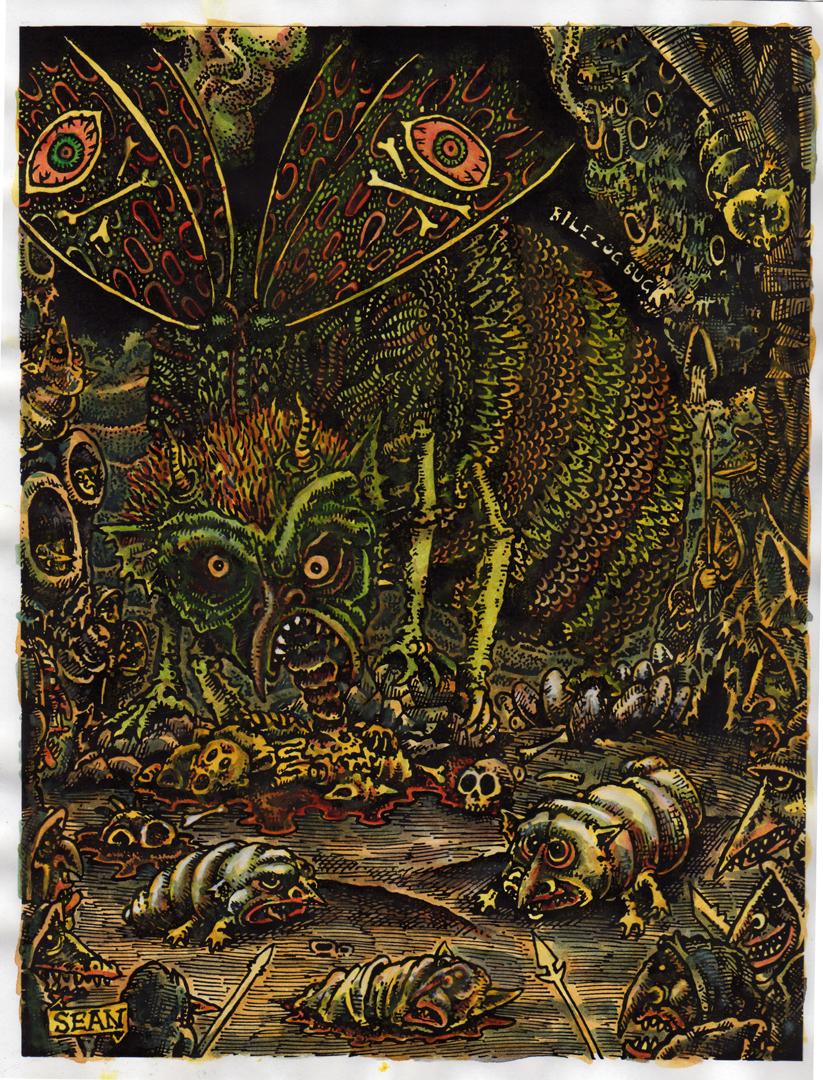
Dungeon Crawl Classics has got me thinking about monsters lately. Like the Random Esoteric Creature Generator, the maxim of DCC is that no encounter with an enemy should be the same. Monsters are aliens, outsiders, and the demons of folk lore. They do not play by the rules of nature that bind men and earthly creatures, nor do they come in the familiar forms and images that mortals are accustomed to witnessing. There is a revulsion and fear of the monstrous that goes beyond pointy teeth and sharp claws to something deeper—something automatically rejected by the human psyche.

J. E. Holmes' version of Basic Dungeons & Dragons came the closest to representing this in play. That humble booklet had a dizzying four score monsters, only the first third of which would even make for a fair fight against beginning characters. As has been discussed elsewhere, the peculiarities of the Holmes edition imply an entirely different style of play than later versions of the game, where heroes approach the unknown with far more caution than bravado.

The Dungeon Crawl Classics book calls to the reader from the same mythos, and provides potent support for making an encounter with the monstrous truly weird (including custom charts and tables for humanoids and undead, and random generators for dragons and demons). Lately, however, I have been thinking, "why not go one step further?" What if one were to drop humanoids entirely? What would a world look like, if the only enemies were humans, the undead or the truly hideous and solitary things dreamt up by the Random Esoteric Creature Generator. Heroes would no longer be paired up against equal numbers of opponents, as if combat were merely sport, but would be truly afraid at the discovery of a new fiendish, unknown and threatening being. I want to be there at the table when a new player asks, "Why is this forest crossed off on the map?", only to receive the answer, "The eyeball beast is there. We don't go there anymore."

This attitude towards play is nicely reinforced by DCC's experience point system as well. Interestingly, monsters are not given any challenge rating or experience point total. In fact, there is absolutely no way for a novice judge to estimate the danger a monster poses to the party ahead of actually throwing it at the players. Experience reward is only determined retroactively (one, two, or up to four points), according to how much the players struggled with the encounter. While narrow-minded referees may balk at this innovation, it is actually an incredibly elegant system which breaks the bad habit of thinking of monsters as having some intrinsic point value. The result is far less bookkeeping, more accurate rewards and monsters that are free to be, well, monstrous. After all, if all encounters are scaled to player power and monsters are not allowed to run amok and put the party to flight fully half the time, the literary concept of monster sort of loses its purchase and the game descends into boredom. Humanoids are just one branch of this problem, as they tend to be narratively predictable and mechanically equivalent to the player characters. A world without them is a world of the unknown, something that players can truly be afraid of.

Appendix M: Extra Monsters
Ghost — Nine foot tall, bipedal outsider. Seen indistinctly from the corner of the eye, and invisible, immobile and incorporeal if looked at directly. The Ghost appears to not have a side or back, but is always facing its prey. A silicon based entity, coated with long, dark brown quills. Believed to have only two arms, each ending in 13 to 17 claws. Complexion is a shadowy void marked by two sparkling ochre eyes. Special powers: Transfixing gaze (only when seen in from a reflecting surface), perfect silence, regeneration (with consumption of bloody flesh).

Small, young dragon (13 years). HD 5 (10 HP), Spd 40', poison breath (Fort vs 15, save or die, 1/day), AC 16, 2d20+8 (claw/bite). Ventriloquism (cast at 1d20+2), Hypnotic stare (Will vs 15), Clear passage through vegetation, copper-coloured, chaotic. (Randomly generated from the Dungeon Crawl Classics Roleplaying Game.)

Thursday, July 15, 2010

Reavers from the Wastelands

The original world, tucked away and hidden in the white box, is one of fierce nomadic bands of humans and humanoids that scour the badlands. Why should we think this, when every later edition of the game has portrayed a very different, more civilized setting? A quick look at Volume II gives us our first clues to this barbaric backdrop.

Unlike their later counterparts, original heroes could expect to meet wandering groups of several hundred men and humanoids in the wilderness. Large mobs of humans, in particular, are some of the most common outdoor encounters. This is particularly interesting, given the relatively low numbers of settled communities on the default wilderness map. As others have noted before, the three little brown booklets expected the referee to use Avalon Hill's Outdoor Survival board game for all wilderness adventures, just as much as referee was intended to use Chainmail for combat encounters. Volume III finally gave a scale to this map ("the greatest distance across a hex is about 5 miles", pg 17), meaning each hex represented just over 16 square miles, and the total outdoor map represented 23,740 square miles (or just about the size of West Virginia). It is perhaps surprising that such a massive country has only 9 towns and 26 castles.

Furthermore, we can use the rules for clearing a barony of monsters to determine the average wilderness population of the Outdoor Survival map. In the 1,462 hexes, 601 are clearings, 395 woods, 98 rivers, 36 swamps, 254 mountains and 78 are deserts. By terrain type and encounter odds, this indicates the whole map contains an average of 44 large hordes of men and 41 small parties of heroes. Of the hordes, about 17 are bandits, 12 brigands, 7 nomads, 6 berserkers, 2 dervishes, 2 cavemen, 1 buccaneer and 1 group of river pirates. The heroic parties are equal numbers of fighting-men, clerics and magic-users with an average of 8 individuals per party. All told, this indicates there are 7,588 men roaming the countryside. With only 9 villages on the map, this indicates there are about 843 outcasts per village, which has to be a significant percentage of the total population (if each is a town of 2,500, as S. John Ross suggests, this means one quarter of the human population lives outside city walls).

Granted, Gygax doesn't indicate to us exactly how big each "town" (Volume III, pg 15) on the Outdoor Survival board should be, although the rules for Baronies suggest an estimate of 2,500 is probably not far off. Here, a hero that builds a stronghold is assumed to rule over a base peasantry of around 1,250 villagers in her demesne, some 20 miles distant from the keep. The population density here is about 1 head per square mile, or approximately the same population density as Alaska.

The wandering humanoid population is still significant, although surprisingly lower than the that of men. Compared to the 44 hordes of men, there are only about 6 roaming tribes of orcs (and a similar number of Kobolds, Goblins, Hobgoblins and Gnolls). The relatively lengthy ecological discussion of Orcs in Volume II indicate a possible reason for this. Most of the entry for these humanoids is devoted to their settled life, particularly the defense of their lairs. Half of those found wandering in the wilderness will be escorting wagon trains, which is perhaps evidence of mercantilism. If we assume from this that orcs are at least as settled as their human counterparts, then we can suppose the 990 orcs that wander the Outdoor Survival map are matched by another 3,000 settled orcs (2,000 of which live in caves, 1,000 in villages walled with palisade defenses).

What should we take away from these clues? A world where one quarter of the population is armed and roaming a vast wilderness has tremendous impact on all levels of society. It changes how we should understand the safety of civilization, the economic system, the power of monarchs and how power is conceived generally. With so little stability (one third of the settled populace would have to be constantly mobilized to defend the city walls), rulers would have to rely on shifting alliances with the nomads, and bids for power would likely have rare and dangerous artifacts as their prize, instead of tracts of land or natural resources. Here, the battle between Law and Chaos is sharply realized as a conflict that the forces of order are always on the brink of losing. In this way, the wilderness ecology written into the implied setting of the Original Dungeons & Dragons game tells a striking story of how the early game world might have been imagined. Considering Avalon Hill's Outdoor Survival, combined with the guidelines in Volume II and III, this setting that takes shape is radically different from how those of later official publications were conceived.


Saturday, February 20, 2010

On the Origin of Species

The trend to account for the species of the game world may be traced back to its origins in Gygaxian "Naturalism".  Monster ecology was arguably more a feature of Advanced Dungeons & Dragons and later games than the three booklets of the original game.  The Monster Manual, for example, puts forth a thorough description of Orc biology, economy and society.  In comparison, Original Dungeons & Dragons makes only scant and incomplete depictions of its monsters, often referring back to Chainmail which in turn merely draws upon Tolkien and classic fantasy.  When Volume 2 does describe a monster, the portrayal is noticeably at odds with what would become the D&D canon.  Consider Gnolls, who are initially described as a "cross between Gnomes and Trolls", are then related to Lord Dunsany's "gnoles" in The Book of Wonder (1912) and are finally illustrated to be some gibbering, hunched over, pointy-eared humanoid.  Whether this apparent lack of homogeneity should be written off as accidental or deliberate, it is clear these three, disparate images create a sort of cognitive space for the Gnoll to develop in those early homebrewed D&D worlds.  I believe this space of cognitive dissonance is critical to the legacy of the original Dungeons & Dragons, evidence of the spontaneous creativity and malleability that game encouraged.


Since then, despite the canonical presentation of monsters presented by TSR, the original spirit of the game has persisted, giving rise to countless personal interpretations with referees cleaving their own territory from both surrealism and naturalism.  While creating a monstrous cosmology is a great deal of the fun of forging a new world, it often proceeds on a merely intuitive level as a compromise of what seems "cool" and what seems convincing.  This balance between the surreal and the natural belies a deeper function of monster-making.  We often forget that monsters are one of the core pillars of our fantasy imagination: much more than cohabitants for the world that the heroes will explore, they are made of the stuff of magic, meant to convey the Otherness deeply rooted in fantasy settings.


To this end, I much prefer a monster mythology to a cosmology.  Whereas the latter concerns itself with how monsters are, a mythology is ambivalent to the "Truth" about its subject, instead sufficing to (very deliberately) pursue the narrative impact of the monster.  To credit an excellent example of this, I would refer to Ken Hite's genius portrayal of the Cthulhu Mythos in Trail of Cthulhu.  In that roleplaying game, the alien deities, blasphemous powers and otherworldly creatures are not presented with a fixed biography (whether surrealistic or naturalistic), but are rather offered through manifold different descriptions, each varying wildly in content and form.  Instead of giving the referee a clear picture of how to use the monster, he or she is confronted with a bewildering arrangement of myths.  The point here is not to offer several options and have the referee choose whether a particular "outer god" is either mindless cosmic radiation seeping in from another dimension or an actual alien creature trapped in the natural tunnels underneath Chicago.  Rather, the decontextualization creates a level of confusion that naturally plays off fundamental imaginings at the sedimentary level of our creative consciousness.  Instead of constructing elaborate cosmologies on top of our primitive dreams, myth breaks down our structured and categorical approach to subduing the world and looses the root fantasy extant from when humankind first looked into the deep, dark wilderness of the forest from the safety of civilization.


In a way, original Dungeons & Dragons invokes this primitive state, especially when viewed through novice and unsophisticated eyes.  Unfortunately, it may be hard the jaded modern to scrub his or her imagination of the now canonical monsters that inundate the discourse.  A return to the original fantasy is recommended here, with a keen eye for the fairy tales and short stories read in one's youth.  Only by peeling back the stale orthodoxy of modern fantasy, ironically polluted by gaming influences, and being especially cognizant of monsters as literary devices, can we reclaim a world that is entirely Other, yet speaks more deeply to our ancient, inalienable mythic awareness.

LinkWithin

Related Posts Plugin for WordPress, Blogger...