I have been thinking about this for a long time, and recently the excellent judge's advice in the Dungeon Crawl Classics Roleplaying Game has inspired me finally to give it a try. Amongst the excellent essays in that manuscript is a treatment on campaign geography, which suggests, in part, to "think locally" in terms of player knowledge. In particular, the section on "The Known World" argues to "make your world mysterious by making it small–very small. What lies past the next valley? None can be sure. When a five-mile journey becomes an adventure, you'll have succeeded in bringing life to your world."
This idea has been consonent with my own thinking for a while now, although I have come at the problem from a different direction. A while back, I was having trouble gearing up for the next campaign. I would sketch out an exciting story, only to fail to see the magic in it the next day. I would draw up a great world map, and find it unremarkable afterwards. I realized that painting with these broad strokes and planning an itinery for the players was actually incredibly constraining, not inspiring, to my thinking. By setting my creativity to paper, and clearly defining it, it had lost that spark of imagination, and therefore my interest. I was experiencing referee burnout before the campaign even began.
Frustrated, I turned to some alternate forms of inspiration for a while and left roleplaying behind. I found myself playing old video games again and Zork, in particular. I had grown up on these (and grown out of them, I had thought), but games like the excellent Treasures of a Slaver's Kingdom pulled me back in for a while. I rediscovered that these old text-based adventures were actually immensely satisfying and inspiring. Confined to individual "rooms," exploring the locales of the Great Underground Empire or the Slaver's Kingdom turned reflectively inward, becoming more detailed, immediate, graspable and relevant to the player. If there was a "greater" world that was, by definition, beyond the player, it was well out of sight.
This changed my view of tabletop roleplaying as well, and I returned to my next campaign with a new attitude towards refereeing. I redrew maps as information webs, horizontal cut-aways, brainstormed flowcharts and in many other previously unrecognizable forms. I avoided top-down maps and left distance scales out entirely. The result was an enormously fun and successful Castle Zagyg campaign.
While DCC does not suggest dropping maps entirely, my thinking lately has been pushing more and more towards this end. Increasingly, I am writing down the scenes for my next campaign in list form, or as quickly-jotted notes randomly arrayed on unlined paper. Sometimes I draw lines between them to connect thoughts, but for the most part I leave this decision making until I am actually running the session. Importantly, I no longer feel compelled to explain any coherent logic in the storyline, as my players do a fantastic job trying to make sense of it with me. It requires a little give and take, and the players may or may not be consciously aware that they are shaping this story with me.
The play is more local, and relevant to the players, but the events of the world around them are not completely under their control. I throw the scenes at them which I had dreamed up earlier, and some stick more than others. Players pursue unexpected avenues (which they are wont to do) and play evolves in a living way. This keeps me interested each week, allows me to update the feel of the game according my current inspirations, and avoids the double pitfalls of storytelling that is too much or too little in the hands of the players. So far, I cannot recommend this approach enough.
Appendix S: Extra Scenes
Fight the minotaur prison warden of the black oubliette!
Chase the thief over the red-tiled rooves of Bloodhaven!
Fight extradimensional analogues in the crystal mirror room!
Scale the barren, sheer mountain face to the ominous stone mouth-door (the doorbell/handle is just a black hand-sized hole in the door...)
Query the three hags of the sump (for every question you ask, they ask another in return, but be warned: any topics you reveal will turn out disastrously later!)
That's no golden idol, it's a golden battle-bot! (any damage you do will descrease its value as treasure!)
What did you come up with?
Tuesday, April 10, 2012
Sunday, April 8, 2012
The Classic Experience
As I mentioned previously, Dungeon Crawl Classics Roleplaying Game is posed to be the game of the OSR thus far. But this a tall claim, isn't it? Aren't rules, after all, just rules? Indeed, from first glance, DCC shares all the major tropes found in early editions of the Dungeons & Dragons game. What makes DCC so significant?
While the rules take up the least space in the book, and appear to be broadly descended from traditional Dungeons & Dragons, the differences are subtle and nuanced. Importantly, these new rules require an open mind, as DCC is not merely a distillation of the games that have preceeded it. It is not the perfection of past attempts, or a fine-tuning of a well-worn concept. There is a new theory behind this game which takes us back to the moment we first cracked open the Basic Dungeons & Dragons box as kids and peered in with wonder.
Of course, as we know, D&D developed on a course predestined by its wargaming roots. Chainmail was a set of medieval warfare rules, and the later iterations of D&D that it inspired focused increasingly on characters, combat roles and abilities. In a way, this even sort of made sense; the most memorable aspect of fantasy literature remained the characters, who then became more and more the sole focus of fantasy games. But there is another moment, a spark, that this timeline has long since left behind. This spark lies at the heart of our first roleplaying experience, when we still did not understand D&D fully, and the oceans of our imagination, buoyed by a ravenous diet of novels and art, met with the first shores of a gaming system. There was a tremendous amount of promise in that moment, precisely when we rolled our first strangely-shaped polyhedral, craned over to see the result and thought, "well, what does THAT mean for my character?"
And this moment is precisely where the Dungeon Crawl Classics Roleplaying Game departs from Dungeons & Dragons. While the later focused increasingly on providing easy and clear answers to dice results, DCC harnesses the interpretive moment of the die roll for asking more questions and creating more difficult situations. The use of dice throughout the game creates dots, which players are then inspired to connect according to their experiences. The die roll is always a negotiation, never a prescription, and demands engagement.
A great example of this can be seen in DCC's rules for Mighty Deeds. Warriors lack an attack bonus, and instead get an ascending bonus die that adds to attack and damage. Additionally, warriors are encouraged to describe their maneuvers, tactics and tricks with each attack. The result of the bonus die determines how successful this feat was, challenging the players to rethink how they can best defeat a powerful enemy.
At the same time, the use of dice in DCC tends to create, rather than resolve, conflicts. Wizards must bargain with their patron daemons, and choices always suggest future challenges. On the Goodman Games fora, there has already been at least one story of the dice being read as transforming a character into a greater daemon.
The end result is a little game that packs a lot of punch, with dice rolls that bring up questions instead of providing answers. The kinds of questions that come up in a regular game feed directly from the inspirational literature of Appendix N, giving Dungeon Crawl Classics consistent atmosphere that any swords and sorcery fan can enjoy. Armed with Vornheim, The Random Esoteric Creature Generator and Dungeon Crawl Classics, a referee might feel young again.
Wednesday, April 4, 2012
Crawling Back
After a brief personal hiatus into none of your beeswax, Joseph Goodman's stunning Dungeon Crawl Classics Roleplaying Game has pulled me kicking, screaming and crawling back into the collective imaginings of pulp science-fantasy tales. While the paper edition of this significant work is enough to earn it a worthy place in every bookshelf and collection, with gorgeous art and design from the maker's of The Dungeon Alphabet, the real contribution of this manual to the "Old School Renaissance" is much more fundamental.
We have already seen revolutionary additions to the literature of this reborn hobby. Not only the aforementioned Dungeon Alphabet, but The Random Esoteric Creature Generator and Vornheim have been billed as new ways to imagine a game of Dungeons & Dragons. Instead of providing new variants to an old paradigm, these publications emerged from the fog of our expectations like strange, inexplicable time travelers from another dimension. They were built upon entirely different theory, as if the original game had never been the illegitimate child of generic, colourless wargaming rules and colourful but unruly fantasy literature. They naturally and effortlessly wove story and system, form and function. But these were always partial additions, covering not the basics of play, but only peripheral subjects. There was no foundational text yet.
Of course, it was only natural that the majority of the OSR would follow a much more conservative trajectory. Just like the historical Renaissance in Europe, the movement began as a return to classical form and style. Considering the timeline, the early OSR began merely with an attempt to emulate generic, vanilla fantasy D&D, with HackMaster (2001), Castles & Crusades (2004), OSRIC (2006), Basic Fantasy RPG (2006), Labyrinth Lord (2007) and Swords & Wizardry (2008).
After 4e was released in 2008, the direction of new OSR games and supplements shifted dramatically, and the community really began to focus on alternate directions that D&D could have taken (both thematically and mechanically). There was a strong urge to go back to the literature genres that inspired the original game (particularly Lovecraft and Howard). Just take a look at the slew of Cthulhu & Conan games after 2008: Barbarians of Lemuria (2008), Supplement V: Carcosa (2008), Lamentations of the Flame Princess (2010), Realms of Crawling Chaos (2011), Crypts & Things (2011), Adventurer, Conqueror, King (2012) and Astonishing Swordsmen & Sorcerers of Hyperborea (2012?).
Joseph Goodman's Dungeon Crawl Classics Roleplaying Game builds on these, but significantly is not based on them. Although the drive to discover "the D&D that never was" after the advent of 4e is not unique, the vision of DCC is not a new, even alternative, edition of the Dungeons & Dragons game. It is not the next version of D&D; if anything it is Arduin, it is Encounter Critical in comparison. It is a fundamental and core shift in our understanding of the horizons of collective fantasy storytelling, which weaves dark, trippy and weird tales natively with supporting game mechanics that actually suggest the play promised by the famed "Appendix N". Like the historical Renaissance, this unlikely and unpredicted development is the product of the renaissance coming to full term and finally bearing forth a truly originary work.
Will everyone "get" Dungeon Crawl Classics? Certainly no more than those who saw the value of The Dungeon Alphabet and similar publications. Nevertheless, DCC is significant in that it is the first offering of a core rules that is based on a new theory of the relationship between story and system. While this game is really at its best when producing pure Appendix N action, some will inevitably miss out and simply use it to play the same type of game they have been running for decades. They may even wonder why their Wizard has to make tough choices and dangerous allies, or why their Cleric has to sacrifice to his idol deity or fear the machinations of the gods, or why their Fighter has to actually think carefully and cleverly about how to engage an enemy, or how their Thief seems to have the knack to miraculously pull off any feat at the last moment.
Is DCC really that good? For the casual gamer, it is a wealth of inspiration and ideas that will not disappoint. For those that learn to play it on its own terms, and to let the inspirational fantasy literature and music of that era take the imagination away, the Dungeon Crawl Classics Roleplaying Game is nothing less than the game of the OSR thus far.
Tuesday, November 2, 2010
Transoxania
Over on the HackMaster forums, the question of campaign settings came up. For his part, Topher presented a rather convincing argument for using a historical locale as the basis for a fantastic setting. He points out that, not only is much of the work already done for you, but such a backdrop is already both highly detailed and believable.
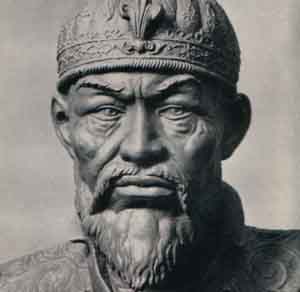
As he mentions, his most recent game is set in a fantasy Samarkand before the rise of the Timurid Dynasty. This is another great contribution, as I suspect many referees (myself included) often neglect the lesser known ancient world as a source to draw inspiring material from. Areas like Transoxania, Bengal and Scythia have always existed on the borders of great empires, but are also themselves the seats of ancient civilization. Transoxania alone saw the rise and fall of countless nations of antiquity which flourished brightly once but eventually disappeared under the sands of time (one thinks of the Sogdiana, Samanid, Kharezmid and Timurid dynasties, to name but a few).
What is perhaps most interesting about these regions is that, not only are they cradles of humanity, but also crossroads and borderlands for very different civilizations and empires. Transoxania accomodated Persian, Chinese, Arab, Greek and Mongol cultures, as well as Buddhist, Zoroastrian, Christian and Muslim faiths. This sort of setting, with its countless variables and a complete lack of the stability found in the neighboring empires, is rife with story potential.
In the future, I'd like to revisit Transoxania in particular, as per Topher's suggestion, as a potential campaign locale. If the readership has similar experience, I would be happy to see this engender a further conversation.
Monday, November 1, 2010
Campaign Frames
Since receiving the unexpected but always welcome guest known as "leisure," I have recently gratified myself in novels again. As a side effect, I have then lately revisited a more narrative style of campaign: something apart from the usual extempore sandbox that I have become accustomed to. Now, I am uneasy to promote a heavily scripted endeavor, but I have been musing about general campaign frames that structure a story, one that hopefully my players might fill out with their choices and blunders alike.
The nice thing about campaign frames, of course, is that they allow you to really dive into strong themes and questions that are otherwise hard to excavate from the erratic and somewhat superficial style of sandbox campaigns. As an example, imagine a campaign frame that started the players out as magistrates working for a pact of sovereigns that ruled peacefully over the nations. A mission to uncover an assassination plot might first be cast as a dutiful defense of the pact, and thus international peace, but would quickly change colour if the assassin's death were to reveal the true grievance; the sub rosa abuse of an underground slave-race by one of the main sovereigns (a witch perhaps, in homage to C.S. Lewis' The Silver Chair). When these atrocities go unacknowledged, the players must choose between sustaining peace or undermining their masters for the cause of justice.
It's also surprisingly easy to incorporate fairly divergent sub-plots. If further investigations led the players to discover that the Brobdingnagians that ruled one country were not natural giants at all, but a race of shape-shifters that had descended from the moon, you could easily delve into elements of science fiction without digressing irretrievably from the original plot line.
This departure from the sandbox style of campaign also requires some mechanical considerations. As the campaign is no longer locally confined, but rather based on a journey that can ultimately span much of the world, character advancement and reward must be adjusted to accommodate the more peripatetic adventuring. Accumulating huge piles of treasure may certainly be a part of this style of storytelling, but it is usually something reserved for the final chapter, and thus the heroes will have to earn their experience points through other means for much of the narrative. One easy way to do this is to introduce story awards, where experience is earned when the heroes uncover plots or unfold plots of their own, thereby encouraging the players to engage the general campaign frame itself. Experience from combat can be similarly reworked, perhaps awarding full reward for each defeated opponent to each player, without the normal subdivision between players.
In any case, I am continuing to think about more narrative campaigns. As long as one reasonably avoids over-scripting, such a campaign can offer an engaging and refreshing change from the whimsical yet shallow experience of the sandbox game.
Monday, October 25, 2010
Height, Weight and Plate Armour
I have always struggled with how best to prevent character inheritance from spoiling the balance of my campaigns. This is brought into special relief by plate armour, which I give to newly rolled up Fighting-Men for cheap (50 coins, as per Men & Magic) and then sell for a much steeper price in the marketplaces of the campaign world. My reasoning is as follows: new warriors should already come equipped with the critical boost of plate armour, but such a powerful resource should be a pricy upgrade for later characters and henchmen. Yet at gaming tables as deadly as mine, those plucky warriors do end up dying, thus leaving their priceless plate for the rest of the party's malfeasance.
Plate armour, of course, is the nicest thing a low-level party has to inherit. At higher levels, inheritance does not cause such imbalance problems in my experience, so I can happily focus my efforts on the specific problem of plate armour. Loathe as I am to import overly artificial or contrived constraints on our favorite numeral three armour class, we must look to the particularities of the historical suit of full plate.
What immediately stands out is that, more so than any other piece of armour (let alone equipment), plate armour is custom tailored to its owner. Here, the height and weight of the wearer are of principle importance. Not only does transferring the suit to a new owner entail a thorough scrubbing to remove any remnants, but the body type of the new ward must be similar enough to the former, lest the suit require an extensive retooling to properly balance and fit comfortably. We must therefore provide a method to determine the height and weight of characters in OD&D. And Lo!;
Height
Human: 5 feet*
Elf: 4 feet*
Dwarf/Hobbit: 3 feet*
*Add 3d6 inches for males or 2d6 inches for females.
Weight
1 Stone per foot (rounded) + 2d6 (average build) or + 1d6 (slim) or + 3d6 (heavy)
For the uninitiated, this results in an average male hero of 5'11" and 182 lbs. If the dispossessed and the new owner are within 3" of height and 3 stone of weight, the inherited armour can be worn without difficulty. Otherwise, the armour must be retooled - to the price of a new suit of armour!
Thursday, July 22, 2010
The Sage
Here is my final optional class for pulpy campaigns: the sage. Also, check out the wanderer and the rogue if you missed them.
Sages: Living on the very border of civilization and wilderness, the reclusive sage is a lifelong student of ancient lore. These eremites have unlocked the secrets of the empyrean and learned how to transcribe both arcane and divine magic into precise formulas. Sages prepare and cast spells exactly as a magic-user and they may also transcribe cleric spells into their spellbook, although due to their peculiar celestial equations they cannot prepare the same spell more than once at a time. Sages have the same restrictions on equipment and magical items as magic-users, but are far more bookish and will only pick up and use a weapon or magic item when pressed by immediate and dire necessity. Otherwise, sages fight, save and require the same number of experience points for each level as magic-users do. Additionally, sages have a superior ability to know fragments of ancient lore, and any elaborations a sage makes on such a piece of knowledge has a chance of being fairly accurate.
| Dice for Acc | Fighting | Spells & Levels | |
| Sages | umulated Hit | Capability | 1 2 3 4 5 6 |
| Recluse | 1 | Man | - - - - - - |
| Hermit | 1 + 1 | Man + 1 | 1 - - - - - |
| Hedge Wizard | 2 | 2 Men | 2 - - - - - |
| Wise Man | 2 + 1 | 2 Men + 1 | 2 1 - - - - |
| Shaman | 3 | 3 Men | 2 2 - - - - |
| Savant | 3 + 1 | 3 Men + 1 | 2 2 1 1 - - |
| Augur | 4 | Hero - 1 | 2 2 2 1 1 - |
| Scholar | 5 | Hero | 2 2 2 2 2 - |
| Magus | 6 + 1 | Hero + 1 | 3 3 3 2 2 - |
| Philosopher | 7 | Wizard | 3 3 3 3 3 - |
| Sage | 8 + 1 | Wizard | 4 4 4 3 3 - |
Subscribe to:
Posts (Atom)