Here is another little freebie for the readers. I couldn't find a good referee's screen that used Chainmail, so I quickly threw one together. The intended layout has the Underworld and Wilderness section as the leftmost pane, the Chainmail tables in the center and the list of monsters on the right. I tried to include only information that would be relevant during a game, so I left out dungeon design notes, treasure tables and so on. Let me know what you think.
Referee Screen for Dungeons & Dragons
Monday, July 19, 2010
Thursday, July 15, 2010
Reavers from the Wastelands
The original world, tucked away and hidden in the white box, is one of fierce nomadic bands of humans and humanoids that scour the badlands. Why should we think this, when every later edition of the game has portrayed a very different, more civilized setting? A quick look at Volume II gives us our first clues to this barbaric backdrop.
Unlike their later counterparts, original heroes could expect to meet wandering groups of several hundred men and humanoids in the wilderness. Large mobs of humans, in particular, are some of the most common outdoor encounters. This is particularly interesting, given the relatively low numbers of settled communities on the default wilderness map. As others have noted before, the three little brown booklets expected the referee to use Avalon Hill's Outdoor Survival board game for all wilderness adventures, just as much as referee was intended to use Chainmail for combat encounters. Volume III finally gave a scale to this map ("the greatest distance across a hex is about 5 miles", pg 17), meaning each hex represented just over 16 square miles, and the total outdoor map represented 23,740 square miles (or just about the size of West Virginia). It is perhaps surprising that such a massive country has only 9 towns and 26 castles.
Furthermore, we can use the rules for clearing a barony of monsters to determine the average wilderness population of the Outdoor Survival map. In the 1,462 hexes, 601 are clearings, 395 woods, 98 rivers, 36 swamps, 254 mountains and 78 are deserts. By terrain type and encounter odds, this indicates the whole map contains an average of 44 large hordes of men and 41 small parties of heroes. Of the hordes, about 17 are bandits, 12 brigands, 7 nomads, 6 berserkers, 2 dervishes, 2 cavemen, 1 buccaneer and 1 group of river pirates. The heroic parties are equal numbers of fighting-men, clerics and magic-users with an average of 8 individuals per party. All told, this indicates there are 7,588 men roaming the countryside. With only 9 villages on the map, this indicates there are about 843 outcasts per village, which has to be a significant percentage of the total population (if each is a town of 2,500, as S. John Ross suggests, this means one quarter of the human population lives outside city walls).
Granted, Gygax doesn't indicate to us exactly how big each "town" (Volume III, pg 15) on the Outdoor Survival board should be, although the rules for Baronies suggest an estimate of 2,500 is probably not far off. Here, a hero that builds a stronghold is assumed to rule over a base peasantry of around 1,250 villagers in her demesne, some 20 miles distant from the keep. The population density here is about 1 head per square mile, or approximately the same population density as Alaska.
The wandering humanoid population is still significant, although surprisingly lower than the that of men. Compared to the 44 hordes of men, there are only about 6 roaming tribes of orcs (and a similar number of Kobolds, Goblins, Hobgoblins and Gnolls). The relatively lengthy ecological discussion of Orcs in Volume II indicate a possible reason for this. Most of the entry for these humanoids is devoted to their settled life, particularly the defense of their lairs. Half of those found wandering in the wilderness will be escorting wagon trains, which is perhaps evidence of mercantilism. If we assume from this that orcs are at least as settled as their human counterparts, then we can suppose the 990 orcs that wander the Outdoor Survival map are matched by another 3,000 settled orcs (2,000 of which live in caves, 1,000 in villages walled with palisade defenses).
What should we take away from these clues? A world where one quarter of the population is armed and roaming a vast wilderness has tremendous impact on all levels of society. It changes how we should understand the safety of civilization, the economic system, the power of monarchs and how power is conceived generally. With so little stability (one third of the settled populace would have to be constantly mobilized to defend the city walls), rulers would have to rely on shifting alliances with the nomads, and bids for power would likely have rare and dangerous artifacts as their prize, instead of tracts of land or natural resources. Here, the battle between Law and Chaos is sharply realized as a conflict that the forces of order are always on the brink of losing. In this way, the wilderness ecology written into the implied setting of the Original Dungeons & Dragons game tells a striking story of how the early game world might have been imagined. Considering Avalon Hill's Outdoor Survival, combined with the guidelines in Volume II and III, this setting that takes shape is radically different from how those of later official publications were conceived.
Monday, July 12, 2010
Thursday, July 8, 2010
The Mmmmmm! System
At my table, I use an informal initiative ordering system, roughly based off the simple turn sequence found in Chainmail and Swords & Spells. Both systems break the combat round down into discrete phases for movement, shooting, spells and close combat. Notably, the sequence in Chainmail provides two steps to fire missiles in the combat round, while Swords & Spells increases this to three shots per round. Yet, both of these games were intended first and foremost to represent mass battles. To portray the freedom and chaos of the small scale skirmishes typical of adventures in Dungeons & Dragons, a little more detail must be hewn from the existing systems.
My sequence, obnoxiously entitled the Mmmmmm! system, is broken down into six steps that are followed through each round of combat, as necessary. The first round of combat still starts with an initiative roll (unless one side is surprised), which is kept through the rest of combat. Each round begins with the players announcing their intended actions. The steps are as follows:
} = Bows/Thrown † = Light Crossbows ‡ = Heavy Crossbows
Missiles: In the Missiles step, all ballistic attacks are made (including artillery), starting with the side that has initiative. Additionally, each later phase is marked by a "Supplementary Missiles" step, according to the type of weapon (as noted above). In this way, bows fire up to six times a round, light crossbows three times, heavy crossbows twice and other weapons (like arquebuses or artillery) fire only once. The supplementary missiles step is taken immediately after resolving the main step (whether magic, mêlée etc.), and if a combatant takes part in the main step, she loses not only any supplementary missile attack from that segment, but also her next scheduled missile attack (whether supplementary or not).
Movement: There are two movement phases that are otherwise identical. Starting with the side that has initiative, combatants can move up to their full normal movement in each phase (12" for men, 24" for cavalry and so on).
Magic: I usually don't allow a spellcaster to move or make attacks in the same round she attempts a spell. Any damage from missiles disrupts the casting.
Mêlée: This step uses the standard rules from Chainmail. While you are locked in mêlée, any non-mêlée action (including supplementary missile attacks, movement, spells and so on) becomes a miscellaneous action (see below).
Miscellaneous: This step is for any remnant action that requires some degree of concentration (such as helping a wounded comrade, imbibing a potion, lighting a flask of oil and so forth). Regardless, you can only perform a single miscellaneous action per round. Whether a player can perform other actions in previous steps and still act in the miscellaneous step is at the discretion of the referee, but any damage taken in mêlée negates the ability to use the miscellaneous step.
My sequence, obnoxiously entitled the Mmmmmm! system, is broken down into six steps that are followed through each round of combat, as necessary. The first round of combat still starts with an initiative roll (unless one side is surprised), which is kept through the rest of combat. Each round begins with the players announcing their intended actions. The steps are as follows:
| 1. | Missiles | |
| 2. | Movement | } |
| 3. | Magic | } † |
| 4. | Movement | } ‡ |
| 5. | Mêlée | } † |
| 6. | Miscellaneous | } |
Missiles: In the Missiles step, all ballistic attacks are made (including artillery), starting with the side that has initiative. Additionally, each later phase is marked by a "Supplementary Missiles" step, according to the type of weapon (as noted above). In this way, bows fire up to six times a round, light crossbows three times, heavy crossbows twice and other weapons (like arquebuses or artillery) fire only once. The supplementary missiles step is taken immediately after resolving the main step (whether magic, mêlée etc.), and if a combatant takes part in the main step, she loses not only any supplementary missile attack from that segment, but also her next scheduled missile attack (whether supplementary or not).
Movement: There are two movement phases that are otherwise identical. Starting with the side that has initiative, combatants can move up to their full normal movement in each phase (12" for men, 24" for cavalry and so on).
Magic: I usually don't allow a spellcaster to move or make attacks in the same round she attempts a spell. Any damage from missiles disrupts the casting.
Mêlée: This step uses the standard rules from Chainmail. While you are locked in mêlée, any non-mêlée action (including supplementary missile attacks, movement, spells and so on) becomes a miscellaneous action (see below).
Miscellaneous: This step is for any remnant action that requires some degree of concentration (such as helping a wounded comrade, imbibing a potion, lighting a flask of oil and so forth). Regardless, you can only perform a single miscellaneous action per round. Whether a player can perform other actions in previous steps and still act in the miscellaneous step is at the discretion of the referee, but any damage taken in mêlée negates the ability to use the miscellaneous step.
Wednesday, July 7, 2010
On Shields, Helmets and Mail
Enough attention has been given to weaponry lately that certainly armours deserve some like consideration. To wit, we shall casually observe some rules–old and new–for shields, helmets and mails; equipments donned by hopeful heroes seeking some protection against the monstrosities of the Underworld.
Shields
There is no need to reinvent the wheel here. With shields, we must note that the rules for Man-to-Man Combat in Chainmail allow one so furnished a superior deterrent against missile attack, particularly when combined with suits of armour. Strapping on a shield with plate armour or chain mail increases your protection against ranged weaponry by bounds (compared to the jejune static +1 of the "Alternative Combat System" found in Volume I). Alternately, we must also note that shields in Chainmail are easily obviated by particular weaponry. Battle axes have a nasty habit of cutting through such impediments, while flails can usually find their way around edge of the shield. Similarly, shields do little to absorb the weight of maces and other blunt strikes.
Regarding magical shields, it is important to recall that the armour class bonus for these items does not stack with the bonus of magical armour. Even when the shield's bonus is superior, it is only taken into account 1 in 3 times (see page 31 of Volume II). Perhaps this can be considered the same odds for the shield to catch a non-lethal projectile as well, instead of using armour class (a rotten tomato thrown by an angry peasant, for example).
If you want more cinematic shields, I recommend Trollsmyth's "Shields Shall be Splintered!" in its most basic form (i.e. mundane shields can be sacrificed to negate a hit, after the damage has been rolled). Magical shields can, perhaps, absorb a number of hits for "free" each session equal to their bonus (after which, they splinter!).
Helmets
These are included in Original Dungeons & Dragons without any explicit rules for their use. Volume II implies that magical helms are hit 10% of the time. For what it's worth, I prefer the Advanced Dungeons & Dragons rule whereby helmets are considered in the overall armour class and attackers will direct attacks against unprotected heads 1 in 6 times. If you are using Chainmail, this is easily represented by levying any attack roll that comes up doubles against the "no armour" column of the Man-to-Man Melee Table (this is also 1 in 6 times, with no particular weighting on strike probability).
Otherwise, helmets would give contextual protection against falling rocks, green slime dropping from the ceiling and so on. They should also limit vision and awareness, making such fighters easier to ambush.
Mails
Like those for helmets, the rules for armour are actually fairly scant in Original Dungeons & Dragons. Volume I implies that a more heavily armoured combatant moves more slowly (a holdover from Chainmail), although instead of using categories of armour ("Light Foot," "Heavy Foot" and "Armoured Foot"), the referee is apparently meant to use weight of equipment. To this effect, a warrior with chain mail, sword and shield could easily fall into the fastest category (12") while carrying extra gear into combat could quickly slow her down to the slower categories (9" and 6" movement a turn). Elves and Hobbits have the same 12" base movement as humans, according to Chainmail, while Dwarves halve this.
If you don't use encumbrance rules, I recommend simply allowing chain-type armour to subtract 3" from movement and plate mail to subtract 6" from movement. Either boost dwarf movement up to 9" to absorb this, or just disallow demihumans from wearing plate armour (incidentally, this is what I do in my campaigns).
In his micro-RPG inspired by OD&D, Searchers of the Unknown, Nicolas Dessaux makes armour class inversely proportional to both movement and initiative bonus. This is a clever way to truly represent how sluggish a warrior is in full armour. A simple way to represent this in Chainmail is to allow the combatant with the faster movement the title of "attacker" when two foes charge at each other. This gives the lighter-armoured opponent a little initiative in striking order, without displacing the importance of weapon class and the initiative roll.
Addendum: Movement
Many others have lamented the oddities that have always plagued movement rates in Dungeons & Dragons. For my part, I like the simplicity of converting outdoor yards to indoor feet, but Gary's figures are still quite baffling. While Volume III allows only two moves per turn (that is, 240 yards in 10 minutes), Chainmail does a little better and allows one move per round (120 yards in 1 minute). Arguably, the latter rate is still too slow, and was likely intended to account for things like keeping formation, waiting on battlefield commands and other delays that do not factor into the small scale skirmishes of man-to-man combat. In my games, I allow two moves per round (in place of, and immediately following, each missile fire). Thus, an unencumbered fighter can run (240 yards per round, or 8 miles per hour) or walk (120 yards per round, or 4 miles per hour). An encumbered Dwarf would move about a yard per second, which also seems right. This is all keeping in mind that close combat range is 3".
Friday, July 2, 2010
The Wanderer
Another optional character class for pulp swords & sorcery games, I present the wanderer.
Wanderers: Considered dangerous savages by society, wanderers hail from the utter ends of the world. These wild men have shunned the ways of civilization for the laws of the wilderness, and have learned how to survive on their own. Relying on their own prowess, wanderers are mistrustful of sorcery and may only use one magical item at a time. They may use any weaponry, but are limited from wearing armour heavier than chain mail. Due to the raw fury of their attack, wanderers gain a bonus to all damage they inflict equal to half their level rounded up. Otherwise, wanderers fight, save and require the same number of experience points for each level as fighting-men do. Wanderers have a superior ability to traverse natural obstacles, navigate difficult terrain, track enemies and survive in the wilderness.
| Dice for Acc | Fighting | |
| Wanderers | umulated Hits | Capability |
| Nomad | 1 + 1 | Man + 1 |
| Wild Man | 2 | 2 Men + 1 |
| Roamer | 3 | 3 Men or Hero - 1 |
| Ranger | 4 | Hero |
| Outlaw | 5 + 1 | Hero + 1 or 5 Men |
| Marauder | 6 | Hero + 1 or 6 Men |
| Outlander | 7 + 1 | Superhero - 1 |
| Wanderer | 8 + 2 | Superhero |
| Barbarian King | 9 + 3 | Superhero + 1 |
| Barbarian King, 10th Level | 10 + 1 | Superhero + 1 |
Monday, June 28, 2010
Spears & Swords in Chainmail
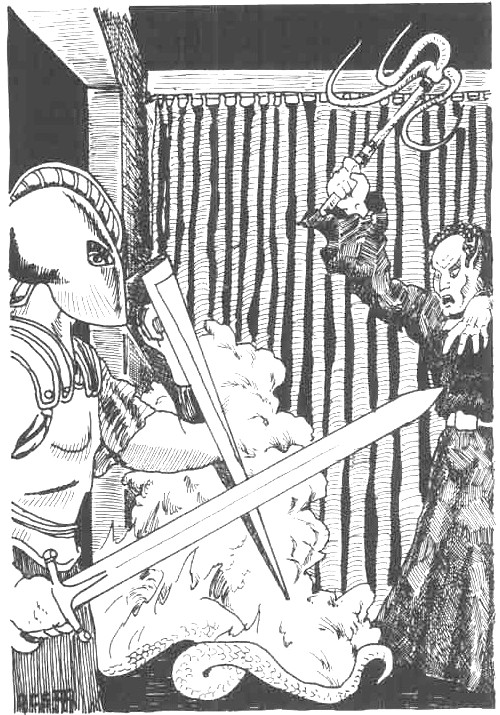
After a quiet May, chipping away at my Master's Thesis, I finally have a breather to talk shop again. I just want to briefly address the noble spear and sword, two ancient and remarkably versatile weapons that perhaps don't get all the respect they deserve in Chainmail.
The spear holds esteem as being the most ancient of elegant weapons - a simple design that invites a profound depth of mastery. Others have bewailed the poor sorts the spear has been dealt before. Indeed, a weapon that E.O. seemed to favor in his art has generally been relegated in Dungeons & Dragons to dealing less damage than the competition, with no advantage granted for its superior length and versatility.
Yet, Chainmail presents much more detailed rules for individual weapon types, and should more than account for the different strengths and weaknesses of each armament. The spear's high weapon class of 8 certainly allows it to strike first against a majority of weapons on the charge. After the first round, however, the high weapon class becomes a disadvantage, penalizing the spear with a subordinate striking order - a drawback meant to handicap unwieldy weapons like the two-handed sword or pike. The parry rules (which could equally represent the quick, warding jabs of the spearpoint) further punish high weapon class, meaning the spear is actually a terrible choice for a defensive weapon.
While I don't think, as Sham suggests in his article, that we need to see a proliferation of magical spears (in comparison to magical swords) to offset this imbalance, I would propose a simple house rule to better represent this humble but graceful weapon. But first, lets take a look at the treatment of the sword in Chainmail.
The sword is, of course, a classic weapon. The flexible design of the sword can be employed to jab, slash and parry with equal authority. Looking at the Man-to-Man Melee Table in Chainmail shows that the sword's weapon class represents this well - it is high enough to outreach simple maces, hand axes and daggers, while it is also low enough to strike faster than (and effectively parry) all other weapon types. The only apparent disadvantage is the low kill number for the sword. It is comparable to neighboring classes of weapons against lightly armoured foes and significantly worse against heavily armoured enemies. I'm loathe to adjust this directly, considering that the aforementioned proliferation of magical swords already impacts this. Instead, I suggest the same presaged house rule to allow the humble, mundane sword even more flexibility to strike faster, more often and to parry more effectively.
Swords & Spears
When wielding these versatile weapons, a Hero may employ the full weapon class or half the weapon class at any time.
This allows swords and spears to strike more quickly (both in terms of number of strikes and strike order) and to serve as excellent defensive weapons (with regards to the rules for parrying), without sacrificing their advantages in reach (due to high weapon class). Thus, spears and swords are good, tactical choices for arms. For blunt striking power, the heavier armaments are still ideal, but if you want an edge in fending off monstrous claws and humanoid weaponry in the dark hallways of the dungeon, or if you value an earlier strike, spears and swords are the weapon of choice.
The spear holds esteem as being the most ancient of elegant weapons - a simple design that invites a profound depth of mastery. Others have bewailed the poor sorts the spear has been dealt before. Indeed, a weapon that E.O. seemed to favor in his art has generally been relegated in Dungeons & Dragons to dealing less damage than the competition, with no advantage granted for its superior length and versatility.
Yet, Chainmail presents much more detailed rules for individual weapon types, and should more than account for the different strengths and weaknesses of each armament. The spear's high weapon class of 8 certainly allows it to strike first against a majority of weapons on the charge. After the first round, however, the high weapon class becomes a disadvantage, penalizing the spear with a subordinate striking order - a drawback meant to handicap unwieldy weapons like the two-handed sword or pike. The parry rules (which could equally represent the quick, warding jabs of the spearpoint) further punish high weapon class, meaning the spear is actually a terrible choice for a defensive weapon.
While I don't think, as Sham suggests in his article, that we need to see a proliferation of magical spears (in comparison to magical swords) to offset this imbalance, I would propose a simple house rule to better represent this humble but graceful weapon. But first, lets take a look at the treatment of the sword in Chainmail.
The sword is, of course, a classic weapon. The flexible design of the sword can be employed to jab, slash and parry with equal authority. Looking at the Man-to-Man Melee Table in Chainmail shows that the sword's weapon class represents this well - it is high enough to outreach simple maces, hand axes and daggers, while it is also low enough to strike faster than (and effectively parry) all other weapon types. The only apparent disadvantage is the low kill number for the sword. It is comparable to neighboring classes of weapons against lightly armoured foes and significantly worse against heavily armoured enemies. I'm loathe to adjust this directly, considering that the aforementioned proliferation of magical swords already impacts this. Instead, I suggest the same presaged house rule to allow the humble, mundane sword even more flexibility to strike faster, more often and to parry more effectively.
Swords & SpearsWhen wielding these versatile weapons, a Hero may employ the full weapon class or half the weapon class at any time.
This allows swords and spears to strike more quickly (both in terms of number of strikes and strike order) and to serve as excellent defensive weapons (with regards to the rules for parrying), without sacrificing their advantages in reach (due to high weapon class). Thus, spears and swords are good, tactical choices for arms. For blunt striking power, the heavier armaments are still ideal, but if you want an edge in fending off monstrous claws and humanoid weaponry in the dark hallways of the dungeon, or if you value an earlier strike, spears and swords are the weapon of choice.
Subscribe to:
Posts (Atom)


