Thursday, February 28, 2013

Unsaved Wounds by Edition: Lethality Creep in Warhammer

Although I have the rules, I have admittedly not played a game of Warhammer Fantasy Battle 8th Edition yet. However, while following online discussions of the game and perusing the new system, I noticed an interesting trend. Units had, across the board, become much more lethal in this edition, with myriad special rules to allow more and more attack rolls.

To be sure, Warhammer has always been known as a "bucket of dice" game, although I have never seen this as a particular fault. The average attack in 3rd Edition, for instance, must roll to hit (an average of 2 in 6) and then to wound (3 in 6) before the opponent can make a saving throw for armour. It might be seen as much quicker to simply allow the attacker a 1 in 6 odds of mortally striking his opponent (which has the same odds as the two previous rolls), yet the rather simple and elegant mechanic of requiring multiple layers of dice rolling allows the game designer to subtly tweak the odds. For instance, a 3 in 6 chance to hit and to wound (or 25% chance to mortally strike) cannot possibly be represented on a single six-sided die roll.

But the recent disturbing trend seemed to force these elegant mechanics to their extremes. By significantly boosting the number of attack dice being rolled, the difference between subtle modifiers to one layer of rolls or another became blurred. The 8th Edition in particular has a number of rules to this effect, whether allowing two ranks of models to strike in melee, or a third with 30+ models in the unit (a "horde"), or an additional further rank with spears or double attacks from additional hand weapons. It soon became quite possible to levy 40 attack dice in one round of melee. Similarly with missiles, archers could now fire in two ranks or half of every subsequent rank for volley fire. An archer regiment arranged in four ranks and ten files could roll 30 attack dice in this manner.

With a sneaking suspicion, I then looked back at previous editions of Warhammer and found that this is not at all a new development. In fact, units have been creeping in lethality since the very first version of the game. I decided to graph the number of unsaved wounds a unit might inflict if arrayed in three ranks and six files (a number that simply made the math much easier). I gave the units a 5+ save and either two-handed weapons, additional hand weapons or spears and crunched the numbers against an identical foe (ignoring initiative, charging bonus and so on). This is what I got:


As you can probably see, lethality has been increasing regularly across the different editions. Some pairs of editions worked very similarly, and more or less represented minor incremental updates on the previous rules (as with 2nd and 3rd, 4th and 5th and 6th and 7th). What's the take away of all this? A cynic might assume Games Workshop has been tinkering with the system over time to make larger and larger armies more necessary. Another option is that perhaps the game designers have been trying to reduce the time it takes to play an average game of Warhammer, making it more accessible for those with a busy schedule. I suspect both of these answers tell part of the story.

Importantly, this trend very much changes the style of game from older editions to newer. In my mind, Oldhammer is very much a detailed, gritty warband skirmish game. Newhammer, perhaps a mass-battle game in 28mm scale. Something that might support this are the changes starting in 4th Edition to radically increase the lethality of combat resolution, a rule change that greatly compounded the general trend in boosted attacks. Here, the leadership of the losing side in a round of combat is almost reduced to nothing, making an average leadership role nearly impossible. Losing combat by only three points, for instance, means a human regiment will flee 83% of the time, whereas there was no such modifier in 3rd Edition and the same human squad would have a better chance of sticking to the combat than fleeing (nearly four times better odds to remain). Furthermore, units that did flee were entirely wiped out, whereas in 3rd Edition they would merely suffer three or four further casualties from the rout. The result was that 3rd Edition warbands, when they did flee, could easily expect to return to the battle later. Later editions made these units much more expendable, resulting in much faster games but perhaps less character and narrative to the warriors fighting the battle.

Wednesday, February 27, 2013

The Grande Review, Part IV


(See also Part I, II and III)

Dwarfs: Tales are still told in the echoing Dwarven halls of the lost grandeur of the old empire. Before the rise of man in the wild lands below, the Dwarfs ruled a mighty imperium that connected the great halls and underground cities across the formidable Worlds Edge mountains. These bulwarks were once thought to be the invincible holds of the Dwarven kings, yet one by one they fell to foes, disease, greed and arrogance. The final blow fell on the stubborn Dwarfs as their realm was overwhelmed from below by an intractable enemy—untold legions of Night Goblins swarming their networks and tunnels, cracking the very foundation of their kingdom with reckless and incessant burrowing. Today, the descendants and scions of this glorious realm still style themselves as Imperial Dwarfs, the fading successors to a crumbling empire. These stalwart heirs still march the overgrown cobbled highways and make pilgrimage to the hallowed halls of their ancestors, looking down upon those Dwarfs that long ago conceded defeat and settled their communities amongst the kingdoms of humankind. For the Imperial Dwarfs, defending the last redoubts of their forefathers is a matter of stubborn pride set against impossible odds. Dwarf armies are typically lead by powerful clan lords, but Dwarven host might also be supported by a Gnome hero or self-taught Dwarf wizard, who can further bind monstrous and ethereal hosts to serve the contingent. The core of the Dwarven warband is made up of various formations of heavy infantry shock troops, ranging from the elite Hammerers to the the veteraned Longbeards and battle-hardened Clansmen. Regular Dwarf Warriors fill out the battle lines, and are supported by ranks of Crossbowmen and Thunderers, wielding the deadly Dwarven arquebuses. Specialist troops include berserk Slayers, who wade into battle with frenzied abandon, as well as Sappers and auxiliary units of Gnome Warriors. While Dwarfs are not natural wizards, retaining only half the magical energies that other sorcerers wield with ease, Dwarven hosts can bring to bear the overwhelming firepower of Dwarven artillery batteries, comprised of numerous bolt-throwers, catapults, cannons and other engines of war. Typical to their rigid views on military strategy, Dwarfs lack skirmishers and cavalry, yet they can depend on Halfling and Old Worlder allies, as well as Old Worlder, Norse and Ogre mercenaries to bring tactical flexibility to the battlefield.

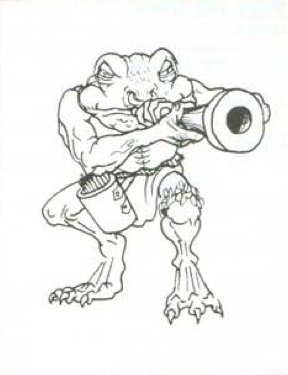
The Slann: Aeons ago, long before the reckoning of man, the world was presided over by a highly advanced race known as the Slann. These amphibian custodians came from the stars to refashion the planet for reasons now consigned to the oblivion, although the rare remaining tablets buried in the steamy jungles of Lustria tell fragments of that story. When the batrachian spacefarers originally discovered the roughly geoid earth, they encountered a developed civilization of lizard people, which they subsequently drove underground with overwhelming firepower and technological superiority. The Slann then used magnetic tethers to pull the world closer to the sun, anchoring it with dual warp-gates, black holes torn into the firmament, over each polar region. With the terrain now inhospitable to previous life, the new stewards set about a program of atmospheric reform and geographic rebalancing, following a model they had employed throughout the thousandfold star systems glittering in the night sky. Here, the Slann developed myriad races and species for research or maintenance work. When their star empire finally fell with the complete collapse of the warp-gate network, the Slann on this world were developing several extremely powerful and dangerous projects. A millennia after their arrival, the catastrophic downfall of the Slann was to stem from a problem long appreciated by their sages, but one which they were eventually unable to overcome—while their interstellar network depended on the chaotic dimension of the warp, the alternate realm inexplicably harbored some formless intelligence, which proved more malignant as its power was probed. After the event, remaining Slann settlers quickly descended into barbarism, striking unspeakable bargains with the malevolent psyches that spilled forth from the polar gates. Retreating to their laboratories in the southern jungle continent, the once vaunted race of spacefarers soon lost mastery and even memory of their fabled technologies, which were left to rust and rot in the humid climes. Today, servitor races of slave eunuchs and genetically-engineered all-female Amazons continue to work menial tasks and tend to the forgotten instruments, while client tribes of Pygmies and tribute legions of Lizardmen now fill the ranks of the opulent and fattened descendants of the Slann. Although their primitivism and barbarism has reduced the Slann to pre-metallurgy armaments, the core of their war parties are made up of a dizzying array of fearsome shock warriors drawn from the Slann braves of satellite villages in thrall to the nearby city-state. These vassal warriors include the formidable Bull Slann Riders, mounted on bloodthirsty Cold One reptiles, as well as the frenzied Warrior Priests, devoted to the mystical deities worshipped by the superstitious Slann. Auxiliary regiments are pressed into service from the lesser savage tribes from the deepest parts of the jungle, serving as skirmishing missile troops, scouts and levy fodder alongside lobotomized human eunuch slaves, tamed troglodytes and Lizardmen tribute warriors. While the Slann lack artillery, they can call on Slann animal handlers driving dangerous jungle creatures forward into combat and consecrated War Altars replete with the fetishes and burning incense of the city-state deities. Slann armies have excellent access to skirmishers from the more barbaric tribes of the inner jungle and can call on Pygmy allies as well. Due to countless blood-stained centuries of sacrifices and dark bargains with Chaos daemons, as well as the remnants of their technocratic history, the Slann have unlimited access to magic, which they can further employ to bind hosts of jungle monsters to their will.

Undead: From forgotten crypts and forlorn mausoleums, the history of the civilizations of the world is ancient indeed. Now lost to time, countless societies rose and fell in the wilderness throughout the long and listless ages of man and more unspeakable creatures, taking with them all of their secrets and revelations. For those ambitious and reckless few, these moldering ossuaries are treasure troves of powerful lore, concealing the answer to the oldest predicament known to humankind—death. Many necromancers thus start down their path of destruction innocently enough, drawn to a misunderstood formula scrawled in the corners of an incomplete magical text or nagging suspicions about a master sorcerer's unfinished work. The result is often much the same, however—a kind of withered undeath in the disemboweled husk of a liche with little memory or love for the life it once knew. When they march forth from their sunken sepulchers to punish the living, Undead armies are headed by powerful wizards who have mastered the necromantic arts, whether Necromancers, Liches or Vampires. While the mindless, rotting legions must remain close to these sorcerers, more independent units can be lead by the spectres of fallen heroes, raised to once more haunt the battlefield. While all of these soulless corpses are immune to human fear and other frailties, the ever-tenuous hold of magic over their animated bones can be disrupted by defeat in combat, causing unpredictable results ranging from the return of more living dead to a complete collapse of the magical fabric that binds them. As Undead armies are raised slowly and painstakingly from the necropolises of forgotten civilizations beyond the frontier, the bulk of these foul legions are typically ancient skeletons, who ride into battle on skeletal steeds or creaking chariots, or might march as a phalanx bristling with spears, great weapons or armed with bows, crossbows and arquebuses. Common rabble is made up of cowardly Ghouls as well as Zombies who, with a faint glimmer of memories still whirling in their rotting brains, can be forced into a rout if threatened by the press of steel. Flammable mummies make up the core of the Undead heavy infantry, while giant Carrion birds cloak the sun and undead catapults pelt the enemy position. At the center of these undead hordes is invariably the Plague Cart, slowly plodding across the battlefield and sowing fear in the enemy while bolstering the threads of magic that hold the rotting army together. On occasion, allied contingents of Chaos or Dark Elves might be seen marching alongside the armies of the Undead, while hosts of monsters or spectres may be enthralled by the more powerful necromancers.

Friday, February 1, 2013

The Grande Review, Part III

(See also Part I, II and IV)

Chaos: For as long as there have been human settlements in the Old World, the North has been known as a dark and blighted wasteland, doomed under the pall of an insidious madness that originates somewhere deep in the northern interior. While the barren steppe is peopleless and empty—punctuated only by wild heaths, insurmountable morasses and the occasional inexplicable and alien cairns—this strange and foreboding wilderness produces a powerful allure for a few. Imperceptible to the vast majority of civilized people, this siren call nevertheless draws a steady stream of dream-tortured mortals from every walk of life, who abandon hearth and home for manic doom as they slip into greater psychosis. Nothing awaits these lost pilgrims. As they travel further north, the barriers of reality break down and they are confronted by impossible terrain and eventually the ebb and flow of pure chaos itself (the
radiation from which would reduce a deranged cultist to component atoms). At times when these reaches swell with the outpour of chaos, a deluge of unformed matter and intelligence permeates the North and drives the solitary mad denizens back south into settled lands. These insane reavers, blessed and crippled with mutations from the Stygian radiance of Chaos, reap a manic harvest of death before stalking back into shadowy Chaos lands. The forces of Chaos could not be thought of as an army in the traditional sense. They have no hordes of fighters, but rather are made up of small bands of champions and anti-heroes, each as powerful or more so than the leaders and heroes of the mortal races. The lower levels of Chaos characters make up the rank and file of heavy shock infantry and cavalry, and are gargantuan knights encased in thick plate armour and bristling with chaotic mutations. Lower
level initiates are made up of thugs, manic brawlers who have not yet guessed their fate. These thewy gangers sport brightly dyed mohawks, pistols and chains, and are the only fighters in Chaos warbands to have no more than a single Wound. Chaos warriors can be joined by the mutated Trolls that wander the outskirts of human lands, as well as by the beastmen and bloodthirsty minotaurs that stalk the woods of the Empire, performing profane rites eerily close to human settlements. Beastmasters can drive the chaos-mutated creatures of the wastes into war and warbands also often build grisly war altars out of the trophies of fallen foes. Being imbued with the raw stuff of Chaos itself, Chaos Wizards have limitless access to every form of sorcery, which also assists them in binding ethereal hosts and chaotic monstrosities. Among their dependable allies, Chaos generals can call on other chaotic warbands, Skaven, Dark Elves, Undead and Orcs and Goblins. With their plunder, they can also recruit mercenaries from the Giants, Hobgoblins, Ogres, Half Orcs and Orcs. While Chaos warbands lack strong missile and artillery support, their powerful infantry and cavalry can strike hard and wade through lesser combatants with grisly ease.

Skaven: In the early Renaissance age of the Old World, the meek and loathsome rat plays an important role. The flea-ridden rodents infest the growing cities, stealing food, carrying deadly plagues and chewing through building foundations to the point of collapse. They are also useful, either as implements of torture in the dungeon oubliettes of the powerful, or as emergency victuals for mariners lost at sea. As humanity begins to spread her arms: there too are lowly rats to be found under her shadow. Few would suspect, however, how important a role these ignoble creatures have yet to play in human history, for deep under the cities and roadworks of civilization, in the forlorn and half-collapsed passageways of the forgotten Dwarf empire of old, dangerous warpstone has spawned hideous rat beastmen. There, in the twilit gloom, these creatures–half-man and half-rat—have been tirelessly working, digging and expanding the tunnels of the underworld, and preparing for an inevitable day when they will rise like an
eschatological wave crashing over the doomed bulwarks of humanity. For now, however, the ratmen marshal their forces and gather the poisonous warpstone that powers their magic and machinery of war. The core of any Skaven army are the Clanrats of the numberless Warlord Clans, from the battle-scarred Stormvermin to the veteran Black Skaven and the common warriors. These light infantry swarm their foes in hordes, and are fast moving and quick to strike, but cowardly when the fight turns against them. Their ranks are further swelled by slave levies: ratmen and even above worlder prisoners captured in war, only to live out a bleak existence underground where the best hope is for a quick death in battle. Some of the more powerful clans have developed their own specialties as well, including Clan Eshin with its deadly scouts and assassins, Clan Pestilens with its blighted Plague Monks, Clan Moulder with its horrible monstrous creations, and Clan Skyre with its mastery over warpstone sorcery and technology. Although they lack artillery and missile troops, Clan Skyre Jezzailachis (large calibre warplock muskets) and warp-fire throwers (which hurl irradiated Chaos flames) provide powerful support to the ratmen hordes. The Skaven's service to Chaos grants them some access to Chaos magics as well as the ability to bind monstrous and chaotic hosts, but Chaos' touch has also mutated the Skaven throngs. When they break the surface to scourge the cities and towns of humanity, Skaven may call upon Orcs and Goblins, Dark Elves and Chaos allies.

Orcs & Goblins: Issuing forth from from the most forbidding mountain tops and impenetrable forests is the single most devastating natural force known to the Old World. While humanity is certainly pressed by calculating foes from without and corruption and incompetence from within, it is rather the disordered hordes of Orcs and Goblins—scattered in dens throughout the Old World—which regularly threatens humankind with near extinction. Collectively known as "Greenskins," these loathsome creatures descend in uncontrollable mobs from their lairs each year to fight not for conquest or religion, but simply to fight, as it is in their bloody humour to endlessly scrap and brawl. Greenskins are not particularly bright or longsighted, and when the enemy is not readily at hand, a gang from one tribe will quickly set about another until the entire warband is caught up in the fray. When
Orcs and Goblins do organize, usually under an exceptionally large and violent specimen of the species, fear and intimidation ranks a deeply hierarchical tribal structure—roughly organized by size, according to who could eat whom. When this happens, Greenskins are at their most dangerous, as they are able to accomplish short and violent campaigns into civilized lands before disorder and significant human sacrifice is able to break the tidal wave and send the scattered brutes wandering back to the deep and dark wilderness. Such an event, known as a "Waaargh!", is a devastating affair, as Orcs torch all structures and eat all prisoners and bystanders after battles in a massive feast, while the more deviously cunning Goblins delight in torturing captured souls or sacrificing them to unspeakable deities. While Greenskins swarm vast pits deep below Old World mountains or high at
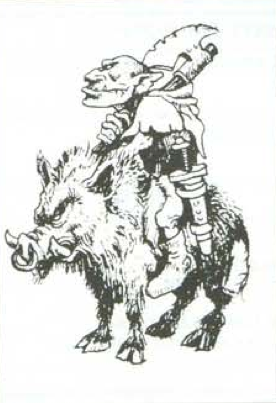
their snowy summits, their main strongholds are in the Dark Lands, over the World's Edge Mountains, where they gather in such number that some philosophers speculate that the race's origins must be somewhere there to be found. Because of the sheer diversity of the race, Orc & Goblin armies can call upon a great range of warriors. The core of most warbands is made up of hardy Orc fighters, who ride boars as medium shock cavalry, drive chariots or march into battle as medium infantry and archers. The strongest Orcs are the elite "Big Uns," whose size indicates their experience (it is not known if Orcs ever stop growing, although most live a life short and brutal enough to make the question largely academic). Goblin raiders sweep across the battlefield on nearly-tamed war wolves and wolf-drawn chariots, while larger hordes of Goblin foot bring spears and bows to
overwhelm the enemy with sheer numbers. Dangerous Goblin Fanatics, lunatic ball-and-chain swinging cultists hopped up on psychoactive brews, are hidden in some ranks of Goblins, only to be released with calamitous effect when the enemy draws near. Primitive Savage Orcs lack all but the crudest of weaponry, but make up for this by working themselves into a wild frenzy, while elite squads of highly-disciplined Black Orcs march out from the Dark Lands to whip their lesser cousins into fighting form. Orc & Goblin armies are further bolstered by scorned Half-Orcs, who are treated as inferior half-breeds by the other Greenskins, miniature Snotling runts and bands of Trolls, lured by the promise of dining on human-flesh. When the battle is brought to the human stronghold, Orc & Goblin generals make use of all manner of war machine to bring down the fortress walls, including Snotling Pump Wagons (a sort of chariot and ram), pilfered organ guns, "spear chukkas" (a type of ballista) and three calibers of stone throwers. While Orc & Goblin commanders try to maintain rank and file amongst their unruly army, archers and Goblins are sometimes allowed to adopt loose skirmish formation, particularly when they are seen as expendable or less important than the melee regiments. Due to their closer dealings with the dark arts, Goblin Shamans have better access to the different spheres of magic, and particularly to Daemonic sorcery, while Orc Shamans dabble enough to know only a few of the secrets. Orc & Goblin wizards can bind monstrous hosts from nearby their wild hideaways and Greenskin generals can summon the support of Fimir, Skaven and Chaos allies, as well as Giants, Ogres, Half Orcs, Orcs and Hobgoblin mercenaries.

Our final article will discuss the remaining armies of the Dwarfs, the Slann and the Undead.

Wednesday, January 23, 2013

The Grande Review, Part II

(See also Part I, III and IV)

The High Elves: Sheltered away on a hidden island across the Great Western Ocean, High Elf society is divided into the arrogant nobles of the inner isle and their more practical Sea Elf kin, who ply the seas off the outer coast. The mercantile Sea Elves are the only natives of the Elven Kingdom, or Ulthuan in the Elven tongue, to regularly contact the Old World. With their marine battalions and nimble fleet, the Sea Elves jealously guard a monopoly of trade routes from Marienburg in the north to Tilea and Arabia in the South, while their aristocratic cousins content themselves with the occasional courtly duel or fueding skirmish in the island interior. The High Elf army is made up of warriors from both societies, and benefits from their different specialties. As the wealthy heirs of the High Elves disdain fighting on foot, the Elven
army boasts several elite cavalry regiments, as well as chariots and even squadrons of dragon riders. Elf commoners form archers, scouts and light infantry, while elite house guard provide heavy infantry. The Sea Elves provide mixed-rank regiments, which can fight with bow and melee weapons alike, as well as aerobatic wardancers and marine bolt-batteries (light ballistas). The High Elves have less access to skirmishers, largely preferring to fight in disciplined ranks, but make up for this with the sheer diversity in regiments. While the armies of Ulthuan will not stoop to hire mercenaries, they can call upon the Wood Elves to remake old alliances, and have access to hosts of monstrous creatures and ghostly apparitions from beyond time. The High Elf proficiency in magic also makes them flexible, as aeons of study has granted them limited insight into all the myriad types of sorcery.

The Empire: The oldest and most powerful human realm in the Old World, the Empire is even so crippled with useless and corrupt leaders, rivalrous petty counts and an ignorant and benighted peasantry. The soot-choked urban centers are the home to a rising wealthy merchant class and all manner of new inventions, but are also penetrated by secret societies, hidden cults and dangerous conspiracies. Due to both the darker dealings of the swelling cities and their air of innovation, Empire mages have considerable access to magic, and some even dally in the unspeakable arts. As a traditional late medieval society, the Empire is divided into those who work, those who fight and those who pray, except in a realm so beset by enemies on all fronts, in reality every segment of society—rich or poor—must be ready to fight. The innumerable odd faith denominations provide
powerful shock cavalry in the form of religious orders of templar knights as well as the uncontrollable mobs of frenzied and wild-eyed penitents, who scourge themselves into fevered rage in battle. The feudal lords call upon independent secular orders of elite knights and their own landed gentry for heavy cavalry and armoured footmen. Regular troops are also maintained in the standing armies of local barons and counts, including scouts, halberdiers, crossbowmen and arquebusiers, while peasant levies can be quickly raised to provide musters of pikemen, peasant mobs and hunters. For siege work, imperial ingenuity provides powerful cannon batteries to the noble that can afford them. Empire armies can call upon Halfings, Wood Elves and lesser Old Worlder principalities for allies. The latter can also be hired on as mercenaries, as can Dwarfs, Norse and Ogres. Imperial wizards can bind hosts of monstrous creatures, although demonic and undead summonings are forbidden by common law.

Bretonnia: West of the misty Grey Mountains is a land robed in fog and rain. The rural backwater realm there had risen at one point to the height of power, challenging even the iron and blood armies of the Empire. Corruption and decay have since seized the decadent courts of the Bretonnian king, leaving the rural nobles to look to the defense of their own estates as they are increasingly surrounded by growing darkness. Few liege lords care for the squalor of their people, who live in huddled villages nestled close under the walls of a feudal ruler. Unlike the neighboring Empire, Bretonnia has few cities, and those that do exist serve as the walled fortresses of great noble families. There is a noticeable lack of any burgeoning middle class, and fewer signs of organized religion—Bretonnian peasantry tending instead to superstition and countless folk practices that differ significantly in each further vale. For centuries of rivalry and conflict, the nobility have mastered mounted combat and excel as knights of honour on the battlefield. Bretonnian armies thus have access to four types of heavy shock cavalry, as well as mounted men-at-arms for light cavalry. In the retinues of noble knights can be found footmen men-at-arms as well as city guards wielding polearms and crossbows, peasantry wielding bows and simple weapons and well-equipped brigands. When marching out on campaign, these infantry formations can be supported by a war altar, carrying the bones of heroes revered by Bretonnian superstition, and cannon batteries to make short work of enemy fortifications. Bretonnian generals can call on the support of Halfing and Wood Elf allies, as well as other Old Worlder nations. The latter might also be bought at a price as mercenaries, as may Dwarfs, Half Orcs, Norse and Ogres. The dark and unexplored wilds that envelop the scattered castle villages make a powerful resources for Bretonnian wizards, who have become adept at illusions and elemental magic, as well as binding monstrous hordes of giant frogs, leeches, snails and even the occasional dragon.

Stay tuned, the next article we will explore Chaos, the Skaven and Orcs & Goblins.

Thursday, January 17, 2013

The Grande Review

(See also Part II, III and IV)

It is not quite spring, but I thought I might do a little spring cleaning around here. I have resettled to Boston and my interests have similarly been struck by wanderlust, migrating like nomads to fertile new territory once the mountain passes have thawed. In my ranging I have rediscovered Warhammer Fantasy Battle, and specifically the 3rd Edition (1987). In the growing old school wargaming renaissance scene, this version of the venerable grandfather of fantasy wargames is known as "Oldhammer." I quite approve.

Thus this blog has been repurposed, at least for the time being. I will still keep the old address from Swords of Minaria, but I thought it might be fun to give the page a new name and styling. The Border Princes, for those in the know, is an outlaw region beyond the pale of civilization: a no man's land well beyond the furthest frontier, where ignorant armies clash in the brutal wilderness in a vain effort to carve out a meek kingdom for a short while. If this sounds something like a roleplaying module you have played, then you would not be far from the truth. In reality, Warhammer Fantasy Battle 3rd Edition borrowed as much from roleplaying games as wargames, and was the only version of the game to date that was developed to be fully coterminous and complementary to a roleplaying game (the much lauded first edition of Warhammer Fantasy Roleplay). The things WFB3 has in common with an old school roleplaying game (not the least of which is the requirement of a gamemaster) are enough to term it a hybrid roleplaying-wargame, but the full extent of this is better tackled in a future post.

For the first article that explores the rules and roles in Oldhammer, I wanted to begin a "grande review" of the armies and factions of the Old World. Those who came to the game after the late 80's might be surprised at the sheer diversity of troops available to an aspiring general. The familiar armies are all there, including Dark Elves, Wood Elves, High Elves, the Empire, Bretonnia, Chaos, Skaven, Orcs and Goblins, Dwarfs, Slann and the Undead. Joining these are many other warbands of lesser races, including Chaos Dwarfs, Fimir, Old Worlders, Pygmies, Halflings, Zoats, Giants, Ogres, Half Orcs, Hobgoblins, mercenaries from Nippon and the Norse. This diversity in choice really comes into its own when one takes into consideration the rules for hosts, allies and mercenaries. Each main army can choose up two, three or even five factions as allies and/or mercenaries, making each force truly unique. These warbands are often further bolstered by hosts of monsters, ethereal spectres (including wraiths, wights and ghosts) and Chaotic creatures. Each army certainly has a unique feel, with strengths and weaknesses, but is also able to greatly tailor its strategy with these supporting forces. To get a better sense of this, we will take a closer look at the Dark Elf and Wood Elf forces.

The Dark Elves: The Dark Elves are a Chaotic and Evil race that hails from the bitter cold lands across the Great Western Ocean. Exiled to this harsh frontier millennia ago, the Dark Elves hate their Elf cousins (must always attack them, with +1 to hit and Leadership) and have spent time developing their sorcerous affinity for very powerful demonic and necromantic magic. With such close proximity to the Northern Chaos Wastes, Dark Elf characters and units suffer random chaotic mutations. Within their armies, Dark Elf generals can field assassins hidden in units and frenzied Witch Elves (+1 to hit, wound and save while going berserk). They may deploy an array of dangerous heavy and medium cavalry, including Helldrakes
and Doomdrakes (knights mounted on powerful reptiles), although their infantry is fairly standard rank and file, including crossbowmen (who have access to short range repeater crossbows), armoured warriors and scouts. They can gain further support from animal handlers (driving more dangerous reptiles into battle), repeating bolt throwers (essentially a weak ballista) and a war altar (which acts as a very powerful army banner). They can call on allies and mercenaries to gain access to cheap hordes of expendable troops (Hobgoblins, Nippon, Skaven and Undead) or powerful heavy infantry (Chaos, Fimir and Ogres). They have access to monstrous hosts (including more reptiles and a dragon), ethereals and Chaotic monsters (including Chimeras, Hydras, Jabberwocks and Manticores).

The Wood Elves: The Wood Elves are the scattered remnants of ancient Elven colonies in the Old World, dispersed among the many deep and unexplored forests of that land. They are natural pathfinders, moving through tangled woods with no difficulty, and have spent their time away from their progenitors mastering the longbow (firing to a distance of 36") and becoming adept at illusions and elemental magic. They have access to a limited amount of medium and light cavalry and chariots, which typically patrol the wild heaths at the edge of a woodland kingdom, as well as a dizzying array of missile troops (including armoured Guards, who protect the settlements; Lord's Bowmen, who are the best marksmen in an Elvenking's realm;
regular archer levies and Glade Runner scouts). The Wood Elves also march with lightly equipped warrior kinbands and are further supported by beastmasters, falconers, hidden shapechangers and acrobatic wardancers. While the Wood Elves do not have any artillery, they can rally mighty Treemen to their aid, who are more than a match for most giants. Their access to magical illusions and the great number of troops that may adopt a skirmisher formation (nearly all of their archers, the wardancers and even a unit of cavalry) means that Wood Elf armies can be very elusive on the battlefield. They can summon support from High Elves, Halflings and Zoats (adding to their missiles, magic and cavalry) and monstrous and ethereal hosts.

The next article will cover the armies of the High Elves, the Empire and Bretonnia.

Thursday, August 9, 2012

Questers into the Unknown

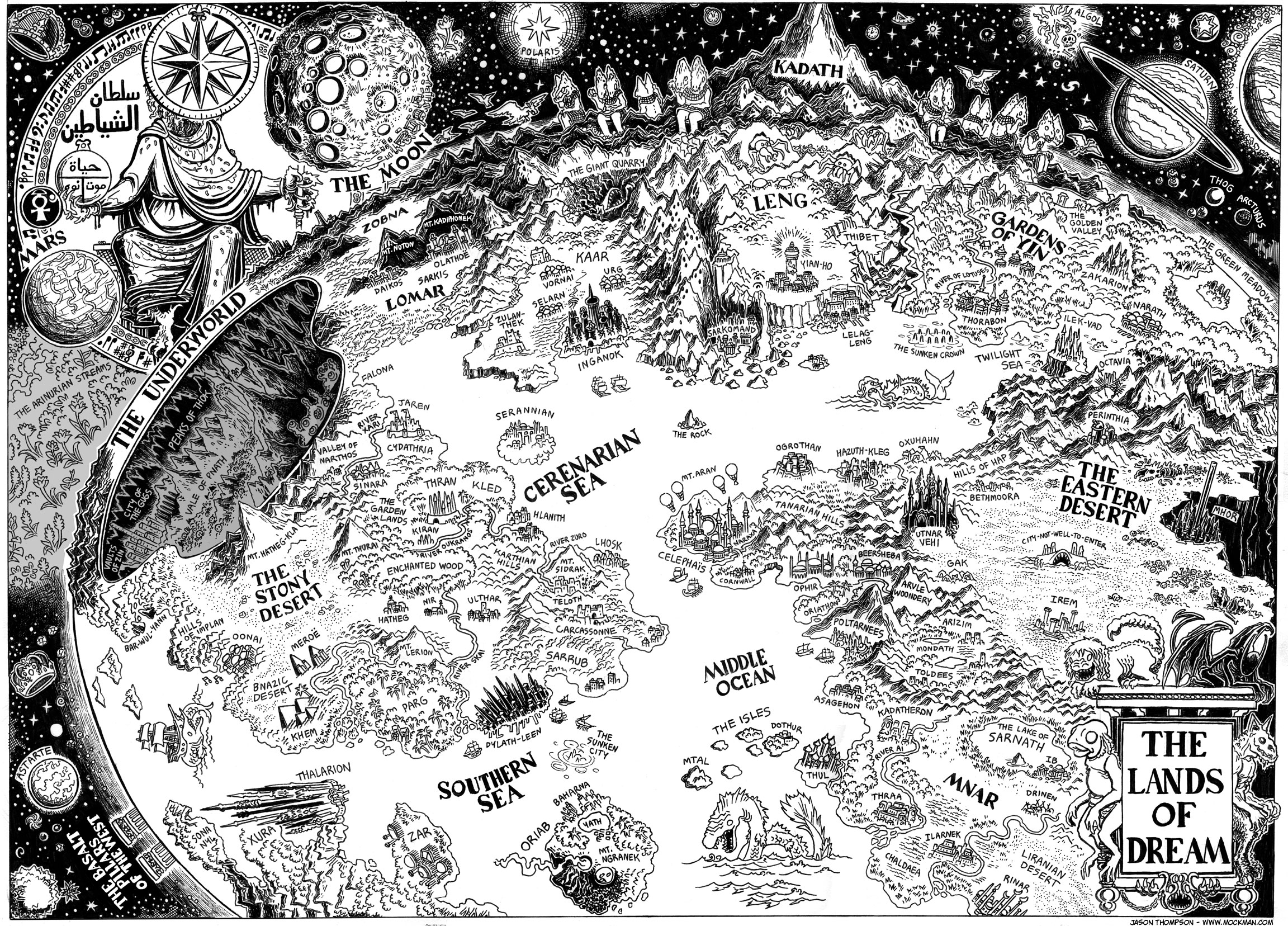
I have been working again on Questers, this time translating it to Dungeon World. So far, this is my progress. Let me know what you think, and I will add it to the blog Treasury for future access. Credit where credit is due, it owes a lot to Vincent Baker (Apocalypse World), Sage LaTorra and Adam Koebel (Dungeon World) and Ryan Stoughton (E6 D&D). And while we are at it, here is an excellent map of Unknown Kadath.

Wednesday, August 1, 2012

Bonded to the World

In many ways, how players are rewarded at the table will define your game, and thus your game world. After all, the world only comes to life in response to the players' action (or inaction), which is then driven by their goals. Rewards give the players an indication of what they should be doing, generally speaking. At the same time, rewards are much more than mere incentives, which would lead players along a predesigned course. Rather, how the players go about achieving these rewards is unique to each group and to each story, and thus rewards must be open-ended. As mentioned in the previous article, players should always be given problems, not answers. How they answer problems is an expression of their freedom within the game world, and is the very narrative of the story itself.

Perhaps a good example of this can be seen in "Old Geezer" Mike Monard's fascinating on-going "tell-all" about the early days of Dungeons & Dragons. As he describes, experience awarded for defeating monsters in the Greyhawk dungeon was almost nothing, perhaps only enough to round off the experience gained from treasure, and that in his own games he does not reward any experience for monsters. The picture that immediately forms is one in stark contrast to modern "dungeon delving" games, with the players cast as "amoral mercenaries out to loot the dungeon," as one commenter put it. Where there is no reward, there is no risk-reward structure, and thus monsters are carefully avoided, like elite soldiers sneaking deep behind enemy lines in some subterranean fantasy Vietnam.

In the same way, a game that does not have a clearly identified reward structure is a game (and a game world) with an identity crisis. Without a framework of rewards (whether fame and fortune, or something else entirely), the players will not have a clear idea of what they should be doing. Without player action to fuel it, the world cannot come to life. This is probably one of the most discussed aspects of Dungeon World, still a work-in-progress, and several iterations of an "experience" system have been proposed (experience being one way to quantify reward).

One of the options that has gained the most traction, although not the current "official" solution, is Ryan Macklin's experiment. A hold-over from the primogenitor game Apocalypse World, this system has each player pick a basic strategy for another player to pursue that session (such as pulling stunts, defending others, acting diplomatically, solving possibles and so on). Each time the player acts accordingly, they earn experience, rewarding immediate and short term narrative styling. Thus, a Cleric (bidden to be more aggressive that session) will show a new angle to his character, as he beats the goblin he interrogates, or lashes out at his superiors in the monastery.

This is a fine system in itself, but perhaps more suited to the game it originated from (Apocalypse World is all about psychologically breaking characters down in a ruined world where no one is granted tomorrow). As forum-goer nemomeme points out, the reward structure determines what the very game is about. We must be careful to think about the essential design goals behind the game before tackling rewards.

So what is adventuring about? The very principles of Dungeon World (which make it so interesting and unique) demand that the fiction comes first. Like microgame adventures, the rules are discrete components that have specific triggers from the fiction, and are otherwise out of sight. The principles also state that the game is a conversation, so thus the rewards should also be in conversation. Perhaps a good model for reward, which is based on the fiction and also in constant conversation, would be Jeff Rient's article on "eXPloration".

Here, I can imagine players and referee discussing, as a group, what they want to do, as it comes up in the fiction. They could even create "experience ladders," listing some goals and objectives. Once players have achieved (or failed) all of their plans for a front (a living, breathing local situation), and the game master has no more moves to make, this should indicate that the front has been fully explored and the next expedition should be chartered. Each player might have a different list, but commonalities and overlaps are expected, as the party is acting within the same local area. An example might be:

• Find the slave camp deep in the jungle (+1 Exp)
• Defeat the Guaraxx lurking in the delta (+2 Exp)
• Get revenge on those pirates (+1 Exp)
• Discover what has made the villagers so frightened, and make it safe again (+2 Exp)
• Climb to the top of White Doom Mountain (+3 Exp)
• Spend a night in the Lost City (+1 Exp)


These goals are constantly being discussed, revised and traded as the fiction dictates, and represent paths of action parallel or tangential to the plot of the front. They give the players a clear idea of what this world is about (that is, the cool and amazing things to do and see, the supernatural adversity to overcome and the bonds to play off between players in the process). In fact, in many ways, this is merely an extension of the bonds rule from Dungeon World, which gives players an initial motivation before the first front is even encountered. Here, in addition to being bonded to each other, the players are bonded to the world. Most importantly, this method lets the fiction come first, which is an essential quality of Dungeon World, and a great deal of what makes it so unique.

LinkWithin

Related Posts Plugin for WordPress, Blogger...